
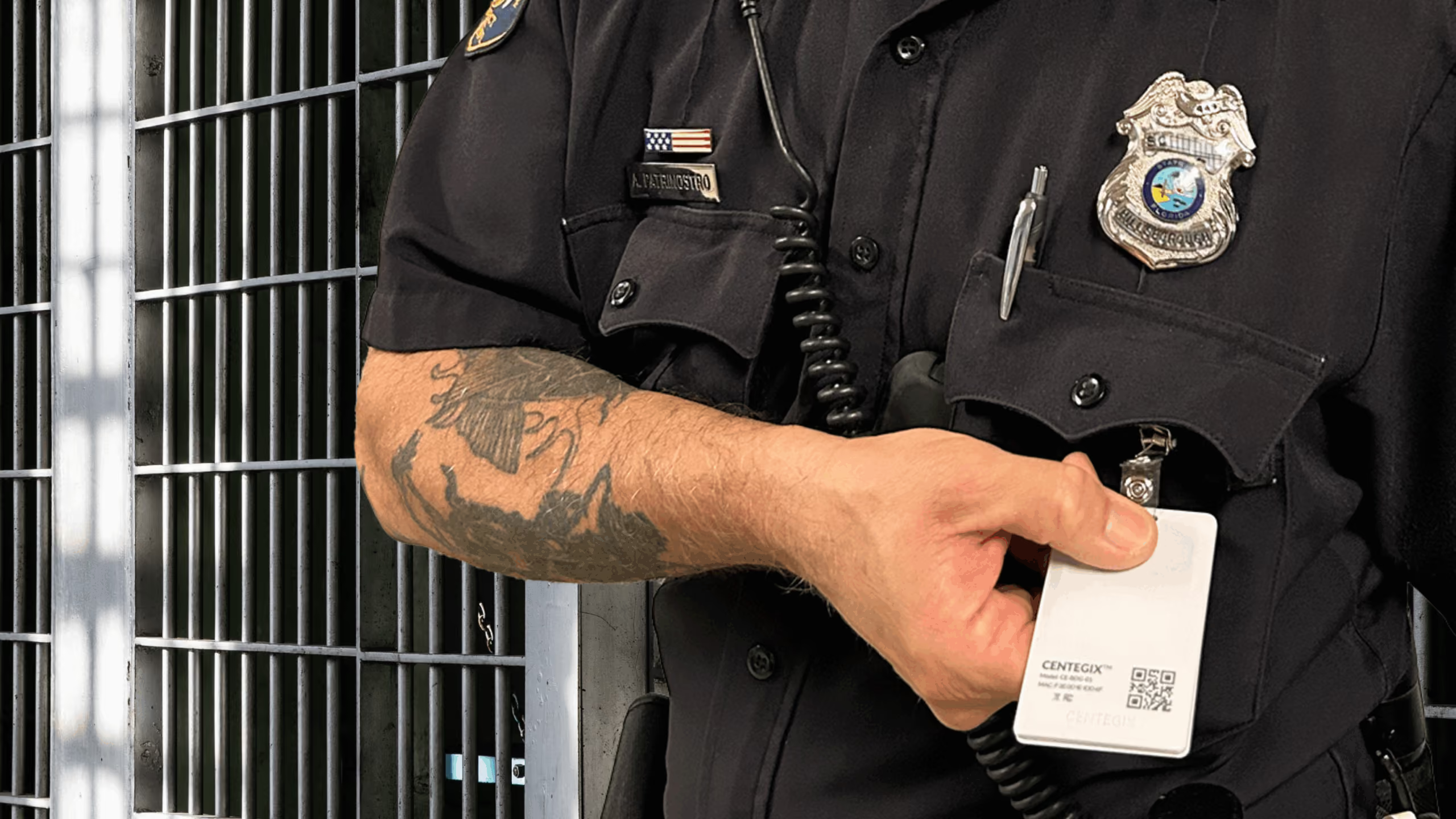
Correctional agencies cannot recruit their way out of a retention problem without also examining the conditions in which officers work. Compensation matters. So do staffing, supervision, schedules, training, career development, and organizational culture. But another factor belongs in that discussion: whether officers believe their employer has given them a dependable way to get help when a routine interaction becomes an emergency.
Improving correctional officer retention requires a comprehensive strategy addressing pay, staffing, workload, leadership, wellness, and workplace safety. Rapid response technology can support that strategy by giving officers an immediate way to summon assistance and by making an agency’s commitment to employee protection tangible. It cannot solve turnover by itself, and its workforce impact should be measured rather than assumed.
Corrections leaders need practical ways to strengthen a demanding work environment and retain experienced personnel.
Why is correctional officer retention a facility-safety issue?
Experienced officers understand housing units, routines, team communication, facility procedures, and the early signs that a situation may be changing. When they leave, agencies lose working relationships and institutional knowledge.
Vacancies also place pressure on the people who remain. Open posts can contribute to overtime, fatigue, schedule disruption, and heavier workloads. The National Institute of Justice has reported that some correctional institutions have experienced severe vacancy and turnover rates, while identifying work environment, staff competencies, training, and leadership development as critical workforce priorities. These challenges vary across systems, but the operational pattern is familiar: staffing strain can make a difficult job harder, and worsening conditions can make retention even more difficult.
The consequences affect the entire facility. The Bureau of Labor Statistics describes correctional work as stressful and dangerous and notes that correctional officers and jailers have one of the highest rates of occupational injuries and illnesses.
Why do correctional officers leave?
There is no single explanation for turnover. Compensation, staffing, shifts, workload, supervision, training, wellness, advancement, and culture all affect whether officers can envision a sustainable future with an agency.
The drivers can also change over an employee’s career. An Office of Justice Programs summary of research involving 2,621 correctional officers found that work-environment factors affected turnover intentions differently across career stages. Organizational commitment, however, was consistently associated with a lower intention to leave.
Retention strategies must therefore extend beyond recruiting bonuses or a single policy change. Workplace safety is one condition that communicates what an organization values when an employee is most vulnerable.
How can workplace safety influence retention?
Safety can shape the employee experience through confidence, trust, and organizational support.
First, officers need confidence that they can request help quickly from a housing unit, recreation area, medical space, sally port, or outdoor area. A fixed button works only when it is within reach; a phone or radio can require multiple steps when an officer has little time or freedom of movement.
Second, officers need to trust that a request will reach the right people. An alert without an actionable location can force an employee to describe where help is needed during a stressful or rapidly changing event. In a complex facility, that uncertainty can complicate response.
Third, a practical means of summoning assistance turns an abstract commitment to safety into something employees can access throughout their shift.
No single technology can resolve correctional officer turnover. A rapid-response platform can, however, address one important part of the work environment: whether an officer can discreetly request assistance and whether responders know where help is needed. CENTEGIX CrisisAlert is designed to give correctional personnel wearable access to help while providing designated responders with the alert holder’s identity and precise location.
Where does rapid-response technology fit in a retention strategy?
The value of a wearable alert extends beyond the button. A modern platform should connect the person requesting assistance with those responsible for responding.
That means agencies should evaluate whether a system provides:
- Wearable, accessible, and discreet activation
- Coverage throughout required indoor and outdoor areas
- Identification of the employee requesting help
- Precise room-, floor-, or zone-level location
- Immediate notification to designated responders
- Digital facility maps and nearby safety resources
- Reliable operation in complex correctional environments
- Alert records that support testing and improvement
The CENTEGIX Safety Platform can connect an employee’s request for help with precise location information, digital facility maps, responder notifications, and incident data that leaders can review to strengthen readiness. These capabilities can help agencies create a work environment in which personnel know that requesting assistance initiates a defined response.
Technology should sit within a layered strategy that includes staffing, supervision, de-escalation, emergency plans, training, wellness, and post-incident support. A wearable panic button helps connect those investments when an incident occurs; it does not replace them.
How can faster, coordinated response protect everyone in the facility?
Correctional emergencies are not limited to assaults. Officers and other employees may need assistance during medical events, fights, self-harm incidents, fires, accidents, and other situations requiring coordinated support. The person needing help could be an officer, civilian employee, contractor, visitor, or incarcerated person.
A faster request can give response teams earlier awareness. Precise location and facility maps can show where to go and identify entrances, rooms, and nearby safety assets.
Faster alerting cannot guarantee an outcome, but it can reduce uncertainty between recognizing a problem and mobilizing response.
What does Tennessee’s statewide correctional safety model include?
The Tennessee Department of Correction’s statewide CENTEGIX deployment offers a current example of an agency treating employee protection as shared infrastructure rather than a disconnected collection of facility tools.
TDOC is deploying the CENTEGIX Safety Platform across all 10 state-operated correctional facilities. Every officer and staff member will receive a CrisisAlert wearable panic button. When an employee activates an alert, designated on-site responders will receive the person’s identity and precise location. Alerts will also route to the department’s new Correction Safety Intelligence Center in Nashville, where personnel will monitor activity around the clock, add situational context, and help coordinate response as needed.
The deployment does not yet establish a reduction in turnover, injuries, or response times. What it demonstrates is a leadership decision to make employee access to help visible, consistent, and statewide.
How should agencies measure safety and retention together?
Agencies should establish a baseline before deployment and review workforce and safety indicators together over time.
Leaders should examine trends by facility and role while remaining cautious about causation. Parallel improvements in safety perceptions and turnover do not prove that one caused the other, but they provide a more complete view of the work environment.
Safety belongs in a complete retention strategy
The strongest correctional retention strategies combine competitive compensation, realistic staffing, effective supervision, manageable schedules, training, career pathways, wellness support, employee feedback, and safer working conditions. Leaving any one of these areas unaddressed can weaken the whole effort.
For agencies evaluating how safety fits into that strategy, CENTEGIX can help identify whether personnel have reliable access to assistance across the entire facility and whether responders receive the location and context needed to act. Closing those gaps will not solve understaffing by itself. It can, however, reinforce a message every corrections employee should hear clearly: when you need help, your organization has prepared a way to respond.
Learn how to reduce search time and improve response clarity today.
Frequently asked questions
Does workplace safety affect correctional officer retention?
Workplace safety can influence retention by affecting employees’ stress, confidence, and perceptions of organizational support. It is one factor among many, including compensation, workload, staffing, leadership, benefits, and career development.
Can wearable panic buttons prevent correctional staff assaults?
Wearable panic buttons cannot prevent every assault or guarantee an outcome. They can give employees a faster, more accessible way to request assistance and provide responders with location information that supports a coordinated response.
Can a staff duress system help protect incarcerated people?
Yes. Personnel may activate an alert for medical emergencies, fights, self-harm, fires, or other incidents involving incarcerated people. Faster notification and clearer location information can help appropriate staff reach the situation sooner.
How should corrections leaders evaluate the workforce impact?
Leaders should compare pre- and post-deployment measures such as safety perceptions, alert activity, response intervals, injuries, overtime, absenteeism, turnover, and exit-interview themes. These measures should be analyzed together without assuming that a single technology caused every change.