
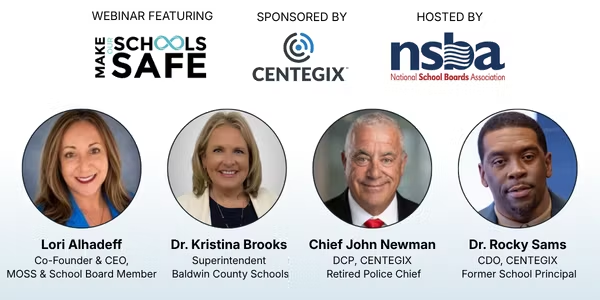
School board members know school safety matters. The harder question is how to turn that concern into decisions that strengthen preparedness across a district.
That question guided From Concern to Action: Leading the School Safety Conversation in Your District, a webinar presented by the National School Boards Association (NSBA), Make Our Schools Safe, and CENTEGIX®. Lori Alhadeff, Broward County School Board member and co-founder of Make Our Schools Safe, joined Chief John Newman, retired Chief of Security and Emergency Management for Hillsborough County Public Schools, for a discussion moderated by Dr. Roderick “Rocky” Sams, Chief Development Officer at CENTEGIX.
Their message gave boards a practical starting point: use policy, funding, and oversight to ensure that school safety is practiced, supported, and accountable. A written plan becomes more useful when employees understand their responsibilities, leaders address identified vulnerabilities, and responders prepare together.
The School Board’s Role in School Safety
School boards advance school safety by setting policy, allocating resources, overseeing district leadership, and connecting stakeholders. During the webinar, Alhadeff described how those responsibilities translate into decisions about locked doors, panic buttons, emergency response, and staff training.
“Make sure that you are holding your superintendent accountable to execute and implement the different layers of safety protection in our schools,” she said.
For Alhadeff, that accountability is personal. After her daughter Alyssa was killed at Marjory Stoneman Douglas High School in 2018, she turned her grief into advocacy and school board service. Her work to build a culture of school safety continues through policy advocacy, staff preparedness, and student engagement.
She shared a specific example from her board work: connecting the superintendent’s evaluation to assessments conducted by Florida’s Office of Safe Schools. The example illustrated how board oversight can give safety implementation a place in leadership evaluation.
Newman reinforced the importance of leadership support. Safety practitioners need board members and superintendents to understand the risks, support the work, and model its importance throughout the district. NSBA President Leonard Lockhart summarized that responsibility in his closing remarks: “Governance, policy, funding, and advocacy are the levers you hold.”
Turning a School Safety Plan Into Practice
A school safety plan needs trained people, practiced procedures, and a process for addressing weaknesses. Newman’s account of reassessing Hillsborough County’s readiness after Parkland made that point particularly clear.
“They look good on paper,” he said of the plans he was comparing. “But where they fell apart was at execution.”
He described reviewing his own district’s vulnerabilities and recognizing that established relationships with law enforcement and existing physical security measures did not eliminate gaps. Training and testing became essential to understanding whether the district could carry out its plans.
Alhadeff urged board members to ask whether staff had actually practiced implementing their school safety plan. She also recommended incorporating panic buttons into drills and providing a demo badge so teachers could become comfortable requesting help.
The federal Guide for Developing High-Quality School Emergency Operations Plans similarly treats planning as an ongoing process involving community partners, training, exercises, and plan maintenance. Guidance on practicing and validating emergency operations plans provides further context for using exercises and evaluations to improve readiness.
Newman brought the discussion back to practice: “So it is all about preparedness, but it's not just preparedness on a checklist. You really got to practice that.”
For boards, the implication is to ask what exercises revealed, what needs to change, and whether district leaders have followed through. The full webinar conversation explores how that oversight supports implementation.
Connecting School Safety Funding to Identified Risks
School safety funding should address the vulnerabilities a district has identified. Alhadeff described a school security risk assessment as a game plan for deciding where resources should go.
Newman offered two connected questions: Are our campuses safe, and what do you need to make them safer? He encouraged leaders to ask for an explanation of existing protections rather than accepting a general assurance. An officer on campus, for example, is one part of a layered approach; that person cannot be everywhere at once.
The CISA K–12 School Security Guide and School Security Assessment Tool support this approach through vulnerability assessment and layered physical security planning. Assessment findings can help boards connect proposed investments to specific gaps in facilities, procedures, or response capabilities.
Alhadeff also urged districts to pursue grants proactively, pointing to SchoolSafety.gov, which has a Grants Finder Tool. District leaders can explore relevant school safety funding opportunities while checking each program’s eligibility, allowable uses, and deadlines.
Funding discussions also need to consider implementation and continued use. Evaluating the value of a school alert system across its lifecycle helps connect purchase decisions to training, staff adoption, maintenance, and ongoing support. Those considerations give boards a fuller picture of what it takes to sustain their safety investments.
Evaluating School Safety Solutions Beyond Compliance
Newman described wanting more than a panic alarm that met a requirement. He wanted employees to call for help during everyday incidents and responders to receive information they could use immediately.
“I wanted to deal with the everyday behavioral issues that you need to call for help and help was going to come,” he explained.
His experience provides a useful lens for evaluating school safety solutions: how does a tool support the district’s actual response? During the discussion, he described equipping 28,000 employees with a way to request help and emphasized the importance of giving staff permission and confidence to act.
“You have to really empower your employees to be able to call for help and let them know that that's also part of their responsibility,” Newman said.
CrisisAlert™ wearable panic buttons provide an accessible way for employees to request assistance. Supporting confident staff adoption remains part of making that capability useful in daily practice.
Newman also emphasized situational awareness: responders need to know who is asking for help and where the incident is occurring. Safety Blueprint® digital mapping supports that need with facility maps and safety asset locations. Providing clear location information during emergency response helps responders understand the campus and locate relevant resources.
For boards, the discussion suggests evaluating safety solutions by their contribution to the whole response: accessible assistance, clear communication, useful location information, and alignment with trained procedures. Reducing delays across identification, notification, and response gives that evaluation a practical focus.
Bringing Stakeholders Together Before an Emergency
School safety governance also involves asking whether the people responsible for responding have prepared together. Alhadeff encouraged tabletop exercises involving law enforcement, EMS, district security, and on-campus security.
“Law enforcement knows what they're going to do, the school knows what they're going to do, but nobody's talking together,” she said, describing the silos those exercises need to address.
She raised specific coordination concerns, including parents arriving at campus and potentially obstructing emergency access. She also urged boards to ask about reunification, drawing on her family’s experience after Parkland. Planning for student and family reunification extends preparedness beyond the initial response.
The conversation also addressed prevention. Newman discussed student supports, and Alhadeff described student-led safety clubs and reporting concerns to trusted adults. The U.S. Secret Service’s Enhancing School Safety Using a Threat Assessment Model recommends a multidisciplinary threat assessment team, reinforcing the value of bringing different expertise together.
Across these examples, coordination gives boards another way to assess preparedness: who participates, what has been practiced, and what gaps still need attention? Newman’s broader lessons about communication failures in school emergency plans underscore why those connections matter.
Questions Board Members Should Ask District Leaders
The panel’s recommendations give boards a starting point for their next conversation with district leadership:
- What vulnerabilities have our school security risk assessments identified, and what is the plan to address them?
- Have employees practiced implementing our school safety plan and using their safety tools?
- Have schools, law enforcement, EMS, and security teams prepared together?
- How will we manage emergency access and student reunification?
- What resources does our safety leadership need, and how will we track implementation?
Alhadeff captured the mindset behind those questions: “ask the tough questions, ask for data, know what is happening in your schools.”
Boards can carry that mindset into policy discussions, funding decisions, and superintendent oversight. Each conversation is an opportunity to connect concern to a specific action and follow up on its completion.
Watch the Full Webinar
The panel’s message was consistent: boards have meaningful ways to advance school safety through their decisions and oversight. Alhadeff brought the perspective of a parent, advocate, and board member; Newman shared lessons from law enforcement and district implementation; and Lockhart urged participants to carry the conversation into their own board agendas and budgets.
Watch From Concern to Action: Leading the School Safety Conversation in Your District to hear their full discussion and bring its questions back to your district.
Frequently Asked Questions About School Safety Governance
What is a school board’s role in school safety?
School boards set policy, allocate funding, oversee district leadership, and engage stakeholders. In the NSBA & MOSS webinar, the speakers emphasized using those responsibilities to support trained staff, address vulnerabilities, and hold leadership accountable for implementation.
What should school boards ask about their school safety plan?
Boards should ask whether staff have practiced the plan, whether response partners have prepared together, what assessments and exercises have revealed, and how identified gaps are being addressed. The discussion also highlighted emergency access and reunification planning.
How can school boards prioritize school safety funding?
Boards can use school security risk assessment findings to connect funding decisions to identified needs. They should also consider training, implementation, and ongoing support, and ask district leadership to investigate applicable grants.
How can school boards hold district leaders accountable for school safety?
Boards can request assessment findings, ask for relevant data, and follow up on corrective actions. Alhadeff shared her approach of connecting superintendent evaluation to school safety assessments as one example of making implementation part of leadership accountability.
What should boards consider when evaluating school safety solutions?
Boards should consider how solutions help employees request assistance, communicate incidents, provide useful information to responders, and support practiced procedures. Staff adoption and everyday use are important parts of evaluating whether an investment meets the district’s needs.