CENTEGIX® | Education
GeorgiaSchool Safety Standards

School Safety Legislation & Resources
Georgia Passes “Ricky and Alyssa’s Law”
On April 28th, 2025, Georgia Governor Brian Kemp signed HB 268, which includes Ricky and Alyssa’s Law, honoring Coach Richard “Ricky” William Aspinwall and Alyssa Alhadeff, a student from Marjory Stoneman Douglas High School in Parkland, Florida. This law mandates that schools maintain accurate maps of their facilities, provide panic button technology for teachers and administrators, and offer an anonymous reporting system.
Georgia is the 8th state to adopt Alyssa’s Law, which requires the installation of panic buttons that are directly linked to emergency responders and law enforcement, ensuring a faster response in critical situations.
CENTEGIX + Georgia School Safety Compliance
- CrisisAlert™ exceeds Alyssa’s Law requirements
- Districts using CrisisAlert are already compliant
- Safety Blueprint™ fulfills the HB 268 school mapping requirement
CENTEGIX protects over 85% of the K-12 public schools in Georgia.
School Safety Recommendations
Earlier this year, Governor Brian P. Kemp presented recommendations for the AFY 2023 and FY 2024 budgets to the General Assembly via the annual Budget Report.
Notable budget proposals in this year’s report include:
- An additional $745 million in AFY 2023 and more than $1.1 billion in FY 2024 for K-12 education, fully funding the Quality Basic Education formula.
- $303 million to adjust the state base salary schedule to give certified education personnel a $2,000 raise. This will bring the total pay increase for educators under Governor Kemp’s administration to $7,000.
- $15 million in grant funds to encourage paraprofessionals to pursue teaching certification, growing the teacher workforce.
- $115 million in AFY 2023 for $50,000 school safety grants to every K-12 school in the state.
- $26.9 million to increase funding for school counselors to help address student emotional and mental well-being.
The Georgia School Safety Plans Law (O.C.G.A. Section 20-2-1185) requires that all public schools develop a safety plan to help curb the growing incidence of violence in schools, to respond effectively to such incidents, and to provide a safe learning environment for Georgia’s children, teachers, and other school personnel. Learn more here.
Georgia School Safety Plans Law
Georgia law directs GEMA/HS to provide school safety training and technical assistance to the education, emergency management and public safety communities of Georgia.
These services are provided through GEMA/HS. It is mandatory (O.C.G.A § 20-2-1185) that all public schools develop a safety plan addressing natural disasters, hazardous materials, transportation concerns, weapons and potential terrorist activities. These School Safety Plans are inclusive and require the input and commitment of students, parents and public safety agencies.
School safety plans shall include, at a minimum, the following strategy areas:
- Training school administrators, teachers, and support staff, including, but not limited to, school resource officers, security officers, secretaries, custodians, and bus drivers, on school violence prevention, school security, school threat assessment, mental health awareness, and school emergency planning best practices;
- Evaluating and refining school security measures;
- Updating and exercising school emergency preparedness plans;
- Strengthening partnerships with public safety officials; and
- Creating enhanced crisis communications plans and social media strategies.
See exactly what’s required here.
Georgia Center for School Safety
The Georgia Center for School Safety (GACSS) is a collaborative effort between the Georgia Department of Education and the Georgia Emergency Management and Homeland Security Agency to provide a clearinghouse for the dissemination of school safety resources, training, and technical assistance to Georgia schools and community partners. Learn more.
School Safety Plan: Guide & Template
During an emergency, schools face many challenges and demands. By law, each public school is requried to develop a school safety plan “to help curb the growing incidence of violence in schools, to respond effectively to such incidents, and to provide a safe learning environment for Georgia’s children, teachers, and other school personnel. Such plan shall also address preparedness for natural disasters, hazardous materials or radiological accidents, acts of violence, and acts of terrorism” (Official Code of Georgia Annotated (O.C.G.A.) § 20-2-1185).
This School Safety Plan guide and templates are designed to be resource tools to help schools develop their School Safety Plan.
Explore the guide here and the template here.
School Safety Assessment
When creating your School Safety Plan, it’s important to assess where your school is currently at in terms of safety. The Georgia Department of Education has provided a School Safety Assessment guide to help evaluate important areas of safety in the school environment.
The level of safety in a school must be assessed using multiple indicators that apply to the total school environment. At a minimum, the assessment process will address the following:
- Safety and Security of Buildings and Grounds
- School Procedures/Guidelines
- Offenses/Consequences Outlined in the Student Code of Conduct
- Role of Law Enforcement/School Resource Officer (SRO)
- Mandatory Reporting of Criminal Activity to Law Enforcement
- Review of the Emergency/Crisis School Safety Plan
- Administrative Procedures
- Staff Development Opportunities Concerning Safety and Legal Responsibilities
- Federal Laws Concerning Students with Disabilities
- Procedures for Data Collection
- Review of Current Discipline Data
- Prevention/Intervention/Student Support Plans
- Opportunities for Student Involvement
- Opportunities for Parent Involvement
- School Climate Surveys
Explore the guide here.
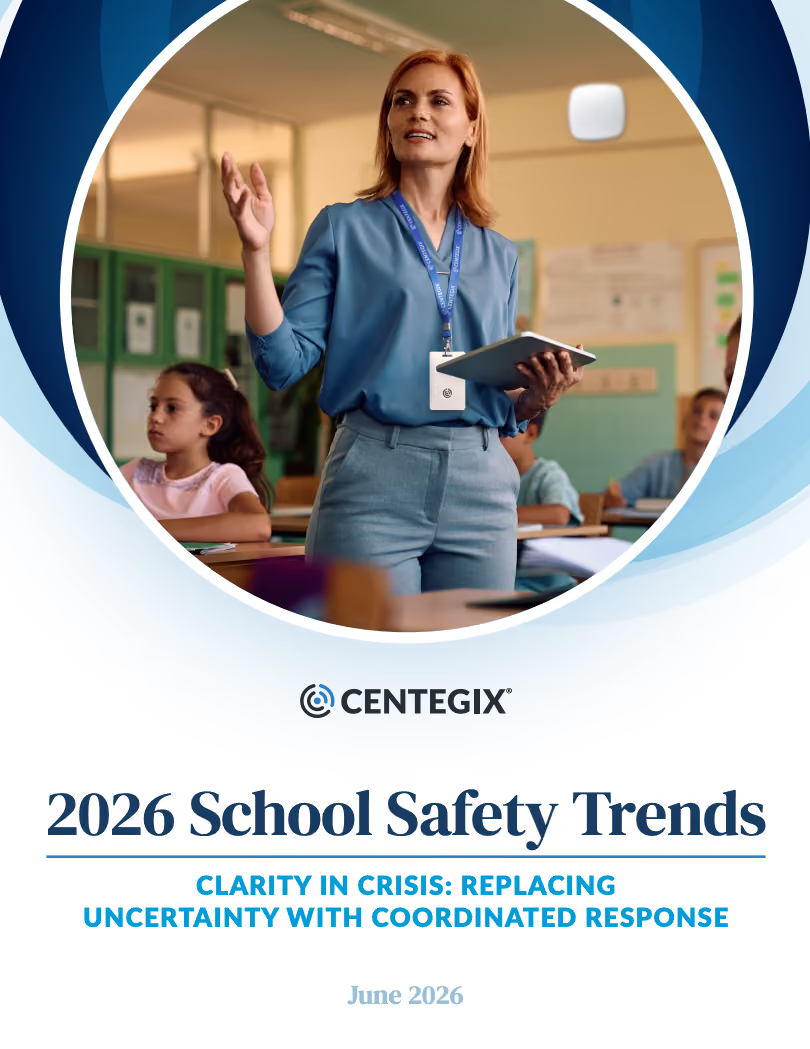
CENTEGIX Safety Report 2026 School Safety Trends:
Clarity in Crisis - Replacing Uncertainty with Coordinated Response
Built from more than 346,000 wearable panic button alerts collected during the 2025–2026 school year, the 2026 School Safety Trends Report provides a comprehensive look at how K-12 schools are improving emergency response, strengthening preparedness, and enhancing campus safety nationwide through clarity.
Download your copy today.
Resources
Resources for Georgia Schools



Proven where it matters most
Real people. Real outcomes.
Education
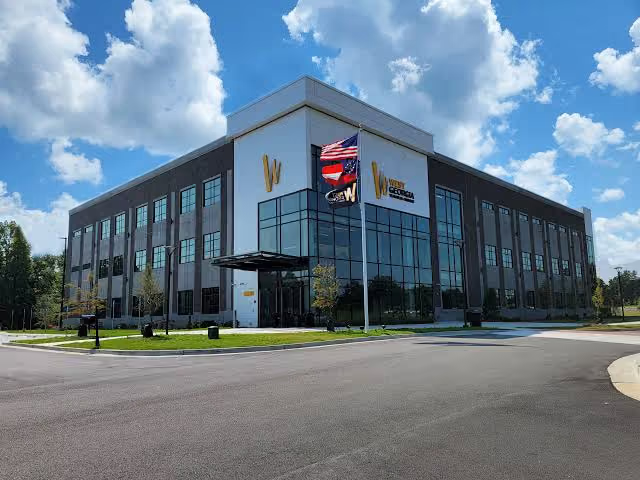
West Georgia Technical College Takes Campus Safety Seriously and Saves Lives Because Of It
See how West Georgia Technical College strengthened campus safety with a connected emergency response solution that helps staff quickly call for help, improves situational awareness, and supports faster response when seconds matter.
Read more
Education
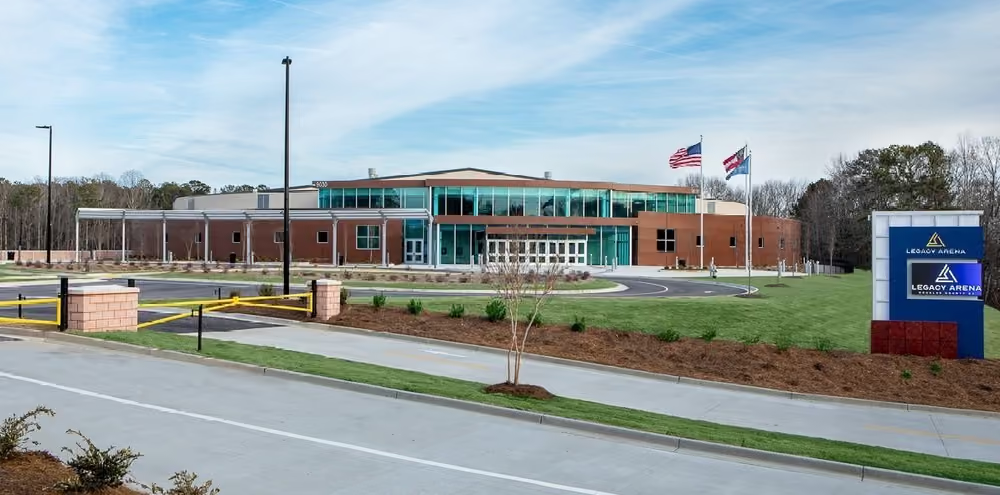
Douglas County Campus-Wide Lockdown
See how Douglas County School System used CrisisAlert™ to quickly initiate a campus-wide lockdown, notify administrators and law enforcement, and keep students and staff safe during a threatening situation.
Read more

Education
Supporting Rural Campus Safety Needs with Wearable Safety Solutions
See how a rural school district uses wearable safety technology to improve communication, speed up emergency response, and help keep staff and students safe across campus.
Read more
Championing Safe Schools with Educators and Educator Associations





Built to respond first
Discover the Safety Platform
Safety solutions that prioritize speed for the best outcomes.

One-Button Ease
A wearable mobile panic button quickly and discreetly initiates alerts.

Location Accuracy
Mapping and locating capabilities provide precise location of emergencies, visitors, and safety assets.

Audio & Visual Notification
Announcements and strobe notifications make everyone aware of a campus-wide emergency.

Two-Way Messaging
Responders stay connected with continuous updates on incident type, location, and response status.

Visitor Management
A visitor management system screens and locates visitors on your campus.

Protocol Development
Plan for rapid incident response with protocols built alongside your team.

Private Managed Network
Campus-wide coverage with 100% grounds coverage and room-level location.

Integrations
Integrations to your existing safety assets to extend their capabilities.
See it for yourself
Ready to Connect with a CENTEGIX Specialist to Learn More?