CENTEGIX® | Education
IowaSchool Safety Standards

School Safety Legislation & Resources
School Safety Improvement Funding
In June 2022, Gov. Reynolds announced $100 million in school safety funding to support Iowa’s 327 public school districts and 183 nonpublic and independent schools during a press conference with the Department of Public Safety, Department of Education, and the Department of Homeland Security and Emergency Management.
This dedicated new funding will provide vulnerability risk assessments free of charge for all 1,500 K-12 school buildings in the state and create a School Safety Improvement Fund, making up to $50,000 available per school building to implement recommended safety measures. School districts can combine these funds with their ESSER funding allocations to cover additional costs to implement safety improvements.
The funding also builds upon the foundation of the Governor’s School Safety Bureau to support all schools and law enforcement partners with prevention, training, and response strategies. A portion of the funding will be utilized to implement technology and tools, including proactive social media scanning software, an anonymous reporting tool, digital critical incident mapping, and specialized training.
Program Objectives
As a response to the increase in mass shootings exacerbated by the pandemic, the State of Iowa has designed this program as a proportional response to the harm experienced. This program addresses the overall pandemic trend of increased mass shootings, and more specifically school shootings.
This program allows schools to perform security assessments in concert with local authorities and assist the schools in creating and improving school security plans; as well as invest in minor capital improvements for security enhancements from one or more of the six categories identified as eligible minor capital improvements.
In June 2022, Gov. Reynolds announced $100 million in school safety funding to support Iowa’s 327 public school districts and 183 nonpublic and independent schools during a press conference with the Department of Public Safety, Department of Education, and the Department of Homeland Security and Emergency Management.
The six categories of eligible minor capital improvements are:
- Entry control
- Electronic security and communication systems
- Barriers
- Perimeter security
- Illumination
- Building envelope
Minor capital improvements include but are not limited to:
- Locks
- ID actuated systems
- Duress alarms
- Intrusion detection systems
- Radios
- Mass notification systems
Maximum Award Determination and Eligible Buildings
What is the maximum award that each school district or nonpublic school is eligible to receive?
For the purposes of this grant, the maximum amount of funds that a school district or a nonpublic school is eligible to receive is based on total school building count multiplied by $50,000 (e.g., three buildings will generate $150,000 in grant funds). The budget for the school safety improvement grant was based on the 2021-2022 building count as reported by each district/system in the 2021-2022 BEDS (Basic Educational Data Survey).
Are the school safety improvement grant funds restricted to the school buildings included in the 2021-2022 building count?
Security improvements on any eligible school building, as defined by the program’s policy, could be eligible for reimbursement (up to the maximum possible award) if the use of funds addresses a security issue identified in the school’s vulnerability assessment.
How is a school building defined?
Per the definitions of school buildings and attendance centers found in Iowa Administrative Code 281-14.3 and 281-17.2, respectively: “Any public or non-public attendance center containing classrooms used for instructional purposes for pre-school, elementary, middle, or secondary school students.” This does NOT include community partner preschools.
Eligibility for Capital Improvement Funding
1. To be eligible to apply for School Safety Improvement funding, a current vulnerability assessment is required. Upon completion of a vulnerability assessment(s), school districts (public and private) may apply for the School Safety Improvement grant funding.
2. The school district must be listed on the 2021-2022 BEDS report, which is used to determine the maximum school safety grant award amount per school district.
3. Proof of appropriate coordination and necessary approval from the State Fire Marshal or the School District’s local fire inspector prior to installation of minor capital improvements and/or other associated security enhancements or modifications will be required to be eligible for reimbursement under this subaward. [Documentation providing proof of this compliance is required as part of the reimbursement request.]
Vulnerability Assessment Requirements
A copy of a valid vulnerability assessment and/or other documentation must be submitted as part of the completed application and meet the following requirements:
- Must include defined vulnerabilities and options for consideration to mitigate vulnerabilities
- Any vulnerability assessments completed prior to the application cannot be more than 3 years old
A vulnerability assessment must be completed by one of the three options listed below:
- Assessment by the State of Iowa and/or the State of Iowa contracted 3rd party entity
- Assessment by Law Enforcement
- Assessment by Vulnerability Assessment Services Providers (Contracting with a VASP will not be a reimbursable expense; a vulnerability assessment completed utilizing a school self-assessment tool or VASP other than the State of Iowa and/or the State of Iowa contracted 3rd party entity will be required to have an official letter from local law enforcement validating the vulnerabilities and options for consideration identified from the self-assessment.)
Superintendents and head nonpublic school administrators can request an assessment through the School Safety Vulnerability Assessment Survey, located in the Other folder on the main Consolidated Accountability and Support Application (CASA) dashboard.
Each school district and nonpublic school that requests a vulnerability assessment through the CASA survey will be contacted via phone by the State of Iowa’s third-party contracted entity, Tetra Tech, to establish communications. Once initial contact has been made, Tetra Tech will work with the point of contact at each district and nonpublic school to schedule their vulnerability assessments.
Key Dates and Timelines
September 1, 2024: Notice of Interest Submission Due Date
October 1, 2024: School Safety Capital Improvement Grants Application Due Date
December 31, 2024: End of School Safety Grant Period of Performance
- The period of performance begins at the time of receipt of the approved subaward documentation and ends on December 31, 2024.
- All costs incurred prior to the approved subaward and after December 31, 2024, are not eligible uses of these funds.
- All costs associated with an approved application must be incurred (obligated to pay) on or before December 31, 2024.
- All work must be completed, and reimbursement submitted to and paid no later than December 31, 2025, or 60 days after the completion of work, whichever comes first.
Ready for Next Steps?
Preparing for Applying
The first step is to obtain a Unique Entity Identification (UEI) number, if you do not already have one. Be sure that your UEI number is publicly viewable. Request your UEI number here.
After completing the School Safety Vulnerability Assessment Survey, via the CASA System, the school district Point of Contact listed in the survey will receive the School Safety Grants Application Package via email, which contains instructions on how to register for access for the School Safety Improvements Program and the School Safety Grant Application Excel file (only school districts that respond Yes to the School Safety Improvement Grant Program question will receive a grant application). Within the EMGrants Portal, you may submit an Access Request for School Safety Improvements funding.
Application Process and Requirements
1. School districts (public and private) must indicate and provide their Notice of Interest (NOI) in the School Safety Improvement grant funding opportunity through completion of the “School Safety Improvement Funding NOI” survey in the Consolidated Accountability and Support Application (CASA) system. The survey is located in the “Other” folder on the main CASA dashboard.
2. Once a school district (public and private) has indicated their notice of interest via the survey, the grant application and instructions will be provided, via email, to the school district’s point of contact designated within their survey response.
3. Verify that the current vulnerability assessment is completed for each school building for which funds are being sought. Vulnerability assessments must include defined vulnerabilities, options for consideration to mitigate vulnerabilities, and meet all other state vulnerability assessment requirements.
4. Submit the completed Excel application and signed documents via upload into the EMGrants portal.
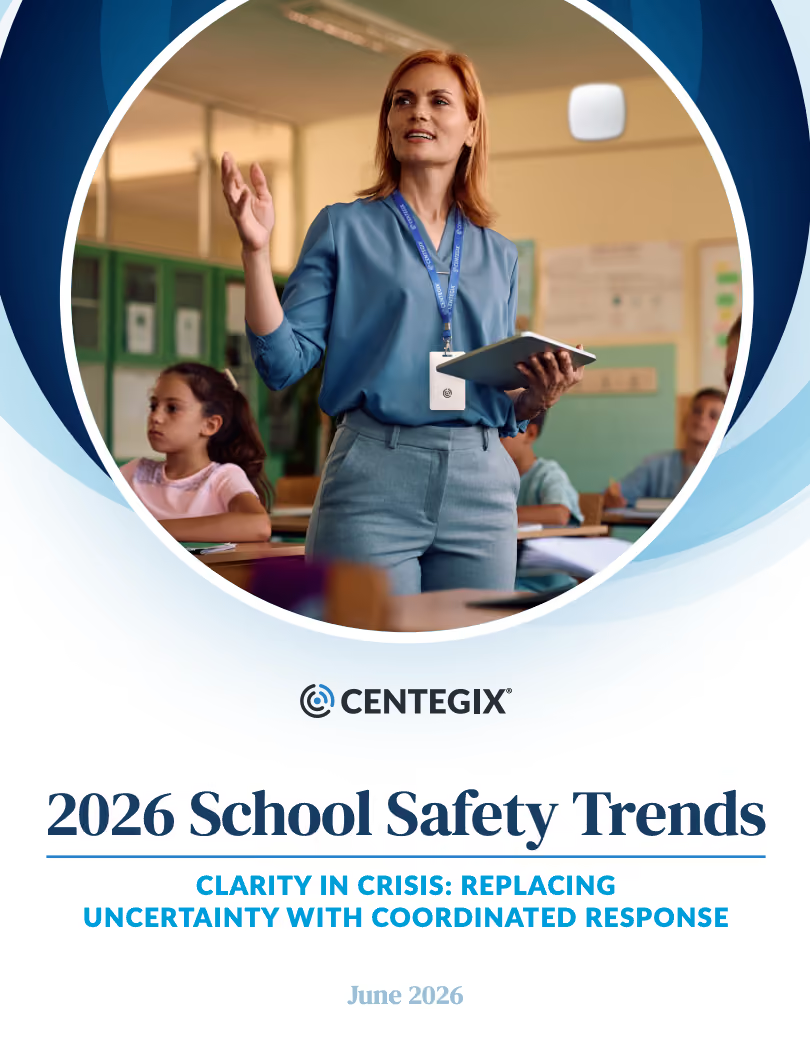
CENTEGIX Safety Report 2026 School Safety Trends:
Clarity in Crisis - Replacing Uncertainty with Coordinated Response
Built from more than 346,000 wearable panic button alerts collected during the 2025–2026 school year, the 2026 School Safety Trends Report provides a comprehensive look at how K-12 schools are improving emergency response, strengthening preparedness, and enhancing campus safety nationwide through clarity.
Download your copy today.
Resources
Resources for Iowa Schools



Proven where it matters most
Real people. Real outcomes.
Education
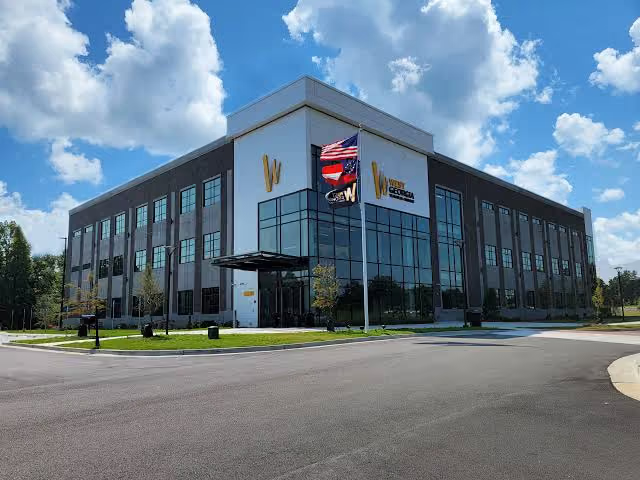
West Georgia Technical College Takes Campus Safety Seriously and Saves Lives Because Of It
See how West Georgia Technical College strengthened campus safety with a connected emergency response solution that helps staff quickly call for help, improves situational awareness, and supports faster response when seconds matter.
Read more
Education
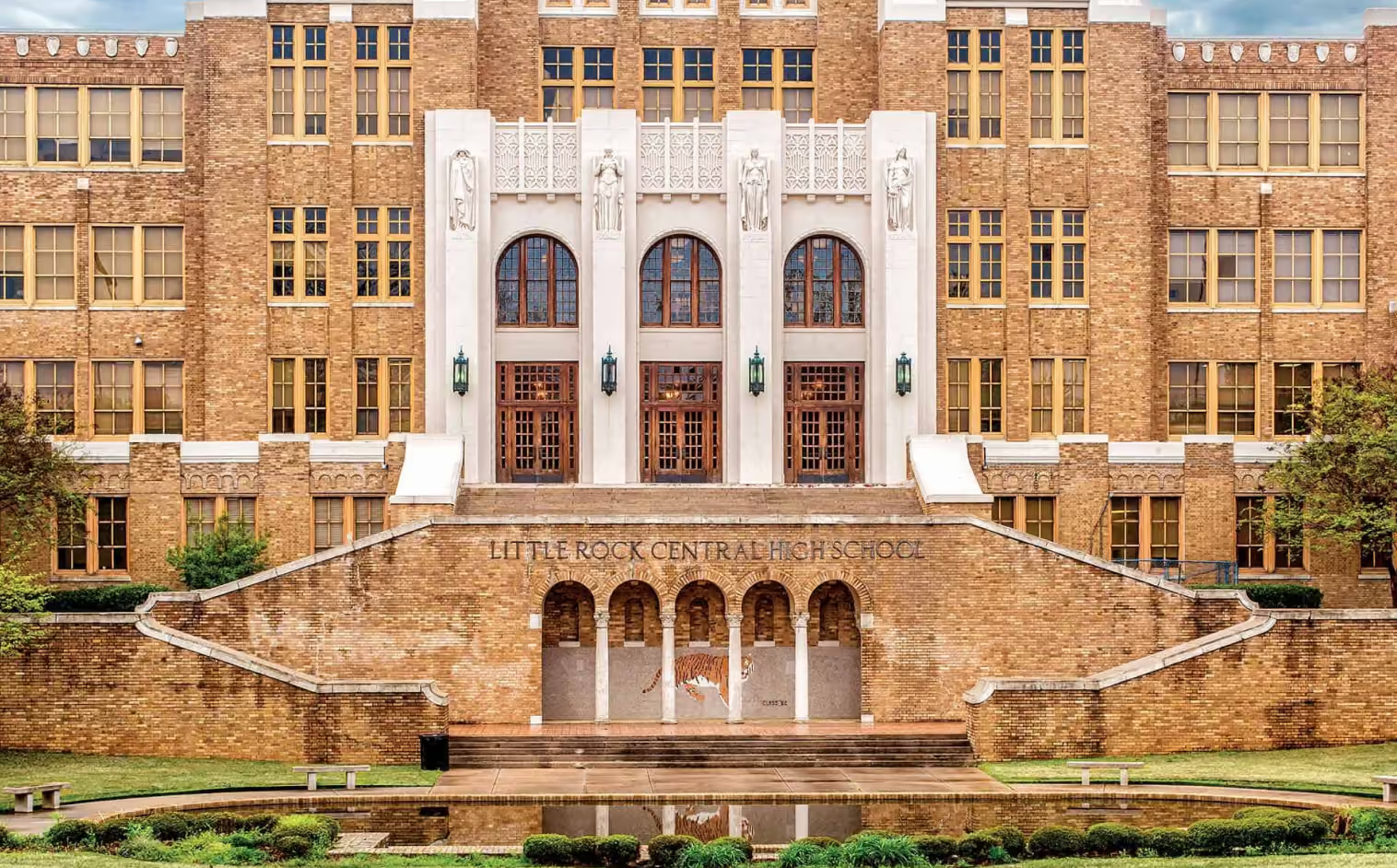
Little Rock School District: Gains Full Staff Adoption
See how Little Rock School District tripled staff adoption of its safety solution, empowering more employees to quickly call for help and strengthening emergency preparedness across the district.
Read more
Education
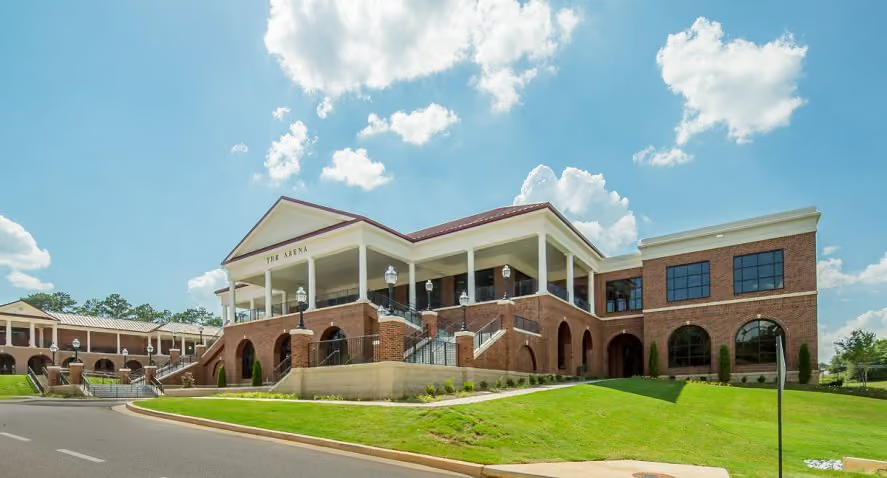
Jefferson City School District Uses CrisisAlert™ Analytics Dashboard to Improve School Climate
See how Jefferson City School District uses CrisisAlert™ analytics to gain insights into safety incidents, identify trends, and make data-informed decisions that support a safer, more positive school climate.
Read more
Championing Safe Schools with Educators and Educator Associations





Built to respond first
Discover the Safety Platform
Safety solutions that prioritize speed for the best outcomes.

One-Button Ease
A wearable mobile panic button quickly and discreetly initiates alerts.

Location Accuracy
Mapping and locating capabilities provide precise location of emergencies, visitors, and safety assets.

Audio & Visual Notification
Announcements and strobe notifications make everyone aware of a campus-wide emergency.

Two-Way Messaging
Responders stay connected with continuous updates on incident type, location, and response status.

Visitor Management
A visitor management system screens and locates visitors on your campus.

Protocol Development
Plan for rapid incident response with protocols built alongside your team.

Private Managed Network
Campus-wide coverage with 100% grounds coverage and room-level location.

Integrations
Integrations to your existing safety assets to extend their capabilities.
See it for yourself
Ready to Connect with a CENTEGIX Specialist to Learn More?