CENTEGIX® | Education
TexasSchool Safety Standards

School Safety Legislation & Resources
Texas Passes Alyssa’s Law
Texas took a major step to secure our schools by passing Alyssa’s Law, critical legislation that will bring panic alarm technology into every school across the state. If you aren’t familiar with Alyssa’s Law, we can help.
What do I need to know about Alyssa’s Law?
- Championed for years by Representative Shawn Thierry (D-Houston) and brought to the Senate by Brandon Creighton (R-Conroe), this bipartisan legislation aims to enhance school safety by requiring schools to install panic alarms that notify law enforcement during emergencies.
- Alyssa’s Law was passed by both the Texas House and Senate, sending the bill to Governor Abbott’s desk.
- When signed into law, Texas schools will have until the start of the 2025-2026 school year to install qualified panic alarm systems.
Is there funding available for Silent Panic Alarm Technology (SPAT)?
Yes. The School Safety Formula Grant, which is administered by the Texas Education Agency (TEA), can provide funding for school districts to purchase and install panic alarms, among other safety measures.
Does the School Safety Formula Grant cover CENTEGIX’s CrisisAlert?
Yes. CrisisAlert exceeds both TEA and Alyssa’s Law standards, provides total campus coverage and offers easy-to-use wearable panic buttons for all school staff, not just teachers.
When is the deadline for the School Safety Formula Grant?
The deadline for the grant application is August 1st.
How can you learn more about Panic Alert Technology or Alyssa’s Law?
Check out our free Texas Alyssa’s Law Resource Guide for more information on Alyssa’s Law in Texas and important dates and deadlines for implementation.
How Do You Evaluate Silent Panic Alert Technology (SPAT)?
To be effective, Silent Panic Alert Technology (SPAT) must have 100% user adoption, be simple and easy to use, and be specific on incident location. To evaluate if a solution will be the right fit for your district, ask these four questions:
Will staff adopt and use the technology?
Staff Adoption is Critical, and Mobile Apps Have Low Adoption. Following the Parkland Florida school tragedy, two months after an emergency response phone app was made available for educators to download, only 16% of one Florida school district staff had it installed on their mobile phones. A Marjory Stoneman Douglas teacher stated, “My cellphone is my private property. But putting [the application] on my phone means now my phone is part of my work property. And having that responsibility to have your phone on you all the time can be problematic.”
When every staff member is equipped with the CrisisAlert badge, you eliminate the need for educators to download an emergency response app to their personal device and achieve 100% user adoption.
Does it rely on wi-fi or cellular to communicate?
Wi-fi and Cell Service in Schools can Be Spotty, Leaving Mobile Apps Vulnerable. In an emergency, EVERY. SECOND. MATTERS. ®. Mobile app-based emergency response solutions that rely on wi-fi or a cellular signal to alert first responders can cost valuable seconds in repsonse time when a reliable signal can’t be found.
With a CrisisAlert badge, a staff member can initiate an alert anywhere on campus without worrying about whether they’re connected to the school’s wi-fi or if they have a strong cell signal. With the push of a button, first responders are instantly alerted.
Does it provide precise incident location to first responders?
Precise Location Information Impacts Response Time, and Mobile Apps Fall Short. Knowing precisely where to go during a crisis is a crucial piece of information for first responders and can determine whether a life gets saved or not. Mobile apps simply can’t guarentee accurate room- and floor-level incident information during a crisis.
When an emergency happens and an alert is triggered with the CrisisAlert badge, first responders instantly receive precise location information of the incident, down to the precise floor level and room number. This allows those in distress to get the help they need as soon as possible.
Will it notify everyone on campus?
Campus-Wide Notifications Protect Everyone, and Mobile Apps Lack the Functionality. When there’s an emergency, campus-wide notification of the event is paramount to ensuring everyone can take the necessary steps to get to safety. Mobile apps lack the functionality to be able to alert an entire campus of an emergency, such as a lockdown, with visual and audio cues.
CrisisAlert uses visual strobes, digital messages, and automated intercom announcements to inform everyone of a campus-wide incident and the actions to take.
Texas Education Agency School Safety Standards
The proposed school safety standards were released by TEA, and with the new requirements are significant grant allocations to offset the costs of improvements. The new standards address the findings in the Robb Elementary School preliminary investigative report that indicated an unsecured door and multiple communications challenges were factors in the tragedy at Uvalde. Learn more about the standards here.
2022-2024 Silent Panic Alert Technology (SPAT) Grant Overview and Requirements:
The purpose of the SPAT Grant is to provide grant funds to local educational agencies (LEAs) to purchase silent panic alert technologies for campuses as a measure of school safety.
Silent panic alert technology is generally defined as a silent system signal generated by the activation of a device, either manually or through software applications, intended to signal a life-threatening or emergency situation (such as an active shooter, intruder, or other emergency situation) requiring a response from law enforcement and/or other first responders. Learn more about the standards here.
2023-2025 School Safety Standards Formula Grant Overview and Requirements
This grant program will calculate formula allocations based on a per-pupil amount per LEA. Grant funds will be distributed by per-pupil counts that were derived from age 3-21 student enrollment as reported in the October 2021 PEIMS submission.
There will be a $200,000 grant allocation for smaller and rural LEAs, even if using the per-pupil methodology they would receive less than the $200,000 minimum grant award.
The grant will allow spending on a variety of security-related items identified by the needs of each LEA. The grant will allow for various costs associated with school safety and security; however, the grant will come with a requirement that money must first be spent on items necessary to comply with the rule.
Once the standards of the rule are met, remaining funds can be spent on other eligible security-related costs as defined in the grant program allowable costs. View grant allocation amounts here.
CENTEGIX Safety Report 2026 School Safety Trends:
Clarity in Crisis - Replacing Uncertainty with Coordinated Response
Built from more than 346,000 wearable panic button alerts collected during the 2025–2026 school year, the 2026 School Safety Trends Report provides a comprehensive look at how K-12 schools are improving emergency response, strengthening preparedness, and enhancing campus safety nationwide through clarity.
Download your copy today.
Resources
Resources for Texas Schools



Proven where it matters most
Real people. Real outcomes.
Education
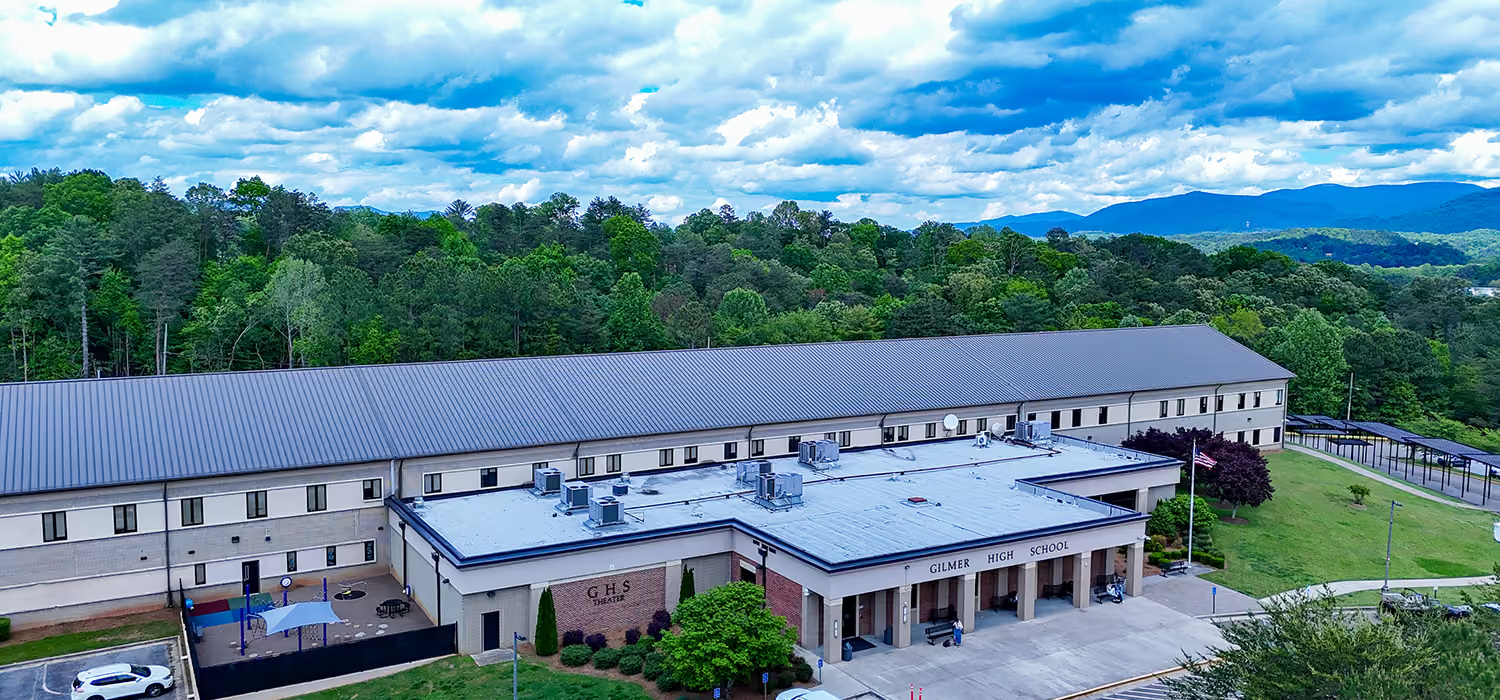
Gilmer County Campus-Wide Lockdown
See how Gilmer County School District used CrisisAlert™ to initiate a campus-wide lockdown quickly, improving communication and coordination during a critical safety incident.
Read more
Education
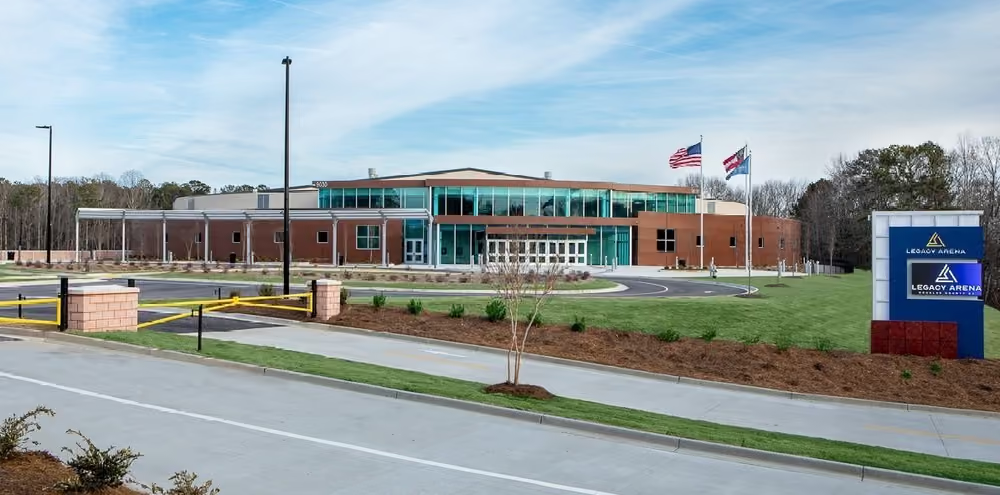
Douglas County Campus-Wide Lockdown
See how Douglas County School System used CrisisAlert™ to quickly initiate a campus-wide lockdown, notify administrators and law enforcement, and keep students and staff safe during a threatening situation.
Read more

Education
West Georgia Technical College Takes Campus Safety Seriously and Saves Lives Because Of It
See how West Georgia Technical College strengthened campus safety with a connected emergency response solution that helps staff quickly call for help, improves situational awareness, and supports faster response when seconds matter.
Read more
Championing Safe Schools with Educators and Educator Associations





Built to respond first
Discover the Safety Platform
Safety solutions that prioritize speed for the best outcomes.

One-Button Ease
A wearable mobile panic button quickly and discreetly initiates alerts.

Location Accuracy
Mapping and locating capabilities provide precise location of emergencies, visitors, and safety assets.

Audio & Visual Notification
Announcements and strobe notifications make everyone aware of a campus-wide emergency.

Two-Way Messaging
Responders stay connected with continuous updates on incident type, location, and response status.

Visitor Management
A visitor management system screens and locates visitors on your campus.

Protocol Development
Plan for rapid incident response with protocols built alongside your team.

Private Managed Network
Campus-wide coverage with 100% grounds coverage and room-level location.

Integrations
Integrations to your existing safety assets to extend their capabilities.
See it for yourself
Ready to Connect with a CENTEGIX Specialist to Learn More?