CENTEGIX® | Education
UtahSchool Safety Standards

School Safety Legislation & Resources
Alyssa’s Law Passes in Utah: Part of House Bill 84
Alyssa’s Law in Utah was signed into law by Governor Spencer Cox and authored by Sen. Don Ipson and Rep. Ryan Wilcox. This legislation, included as part of the Utah’s largest school safety measure, H.B. 84, requires Utah public and charter schools to “provide a staff person in each classroom with a wearable panic alert device that allows for immediate contact with emergency services or emergency services agencies, law enforcement agencies, health departments, and fire departments.”
Alyssa’s Law is named for Alyssa Alhadeff, a victim of the 2018 Marjory Stoneman Douglas High School shooting, and has been championed by Alyssa’s parents, Lori and Dr. Ilan Alhadeff. Alyssa’s Law has garnered support across the political spectrum as a common-sense solution for school safety.
The new law requires schools to adopt emergency communications systems such as CrisisAlert™—part of the CENTEGIX Safety Platform®—a rapid incident response solution that helps protect students and staff members by empowering teachers and staff to immediately get help with a discreet panic button on a wearable badge. CrisisAlert operates via a private network, the ideal solution for schools where gaps in Wi-Fi and poor cellular signals can often disrupt connectivity. With intelligent response mapping and campus-wide notification capabilities, CrisisAlert can simultaneously send a school into lockdown while immediately providing first responders with exact location information, enabling them to respond faster in an emergency situation.
In addition to emergency communication systems, H.B. 84 also mandates:
- School safety incident and data reporting requirements.
- School resource officer training.
- School safety needs assessment requirements.
- School guardian program.
- Designation of certain school safety personnel.
- Additional school safety requirements.
Frequently Asked Questions About Utah’s Alyssa’s Law
What must Utah schools do to comply with Alyssa’s Law?
Under Utah Code Section 53G-8-805, Utah public school districts and charter schools must provide the lead teacher in each classroom with a wearable panic alert device that communicates directly with the appropriate Public Safety Answering Point, or PSAP. LEAs must also ensure that school building personnel receive training on the protocol and proper use of the devices before the school year begins.
Compliance involves more than purchasing panic buttons. District leaders should evaluate whether a solution can reliably connect staff with help, identify precisely where an emergency is occurring, support coordination with first responders, and function throughout the entire campus. The Utah School Safety Playbook provides additional guidance on Utah’s wearable panic alert device requirements and other school safety responsibilities established through H.B. 84.
How can Utah LEAs obtain state-funded wearable panic alert devices for FY27?
The Utah State Legislature has allocated funding to help public K–12 LEAs obtain wearable panic alert devices through USBE’s approved cooperative contracts. To participate, each LEA must complete the FY27 Wearable Panic Alert Device Request Form and select an approved contractor by 5:00 p.m. on Friday, September 18, 2026.
According to the USBE Wearable Panic Alert Devices program page, state funding covers Tier 1 service costs for requests approved by the Utah School Safety Center. Devices or services acquired before formal approval, including previously purchased wearable panic alert devices, are not eligible for reimbursement.
Is CENTEGIX an approved wearable panic alert device provider for Utah schools?
Yes. CENTEGIX is a USBE-approved wearable panic alert device provider, giving Utah LEAs a state-vetted, procurement-ready option for meeting the state’s emergency alerting requirements. District leaders can review CENTEGIX’s cooperative contract and other official program information on the USBE Wearable Panic Alert Devices page.
During USBE’s competitive evaluation, CENTEGIX received the highest overall score among the evaluated providers. The Evaluation Committee determined that CENTEGIX offered the best overall value based on its technical response, reasonable pricing, fulfillment of the required criteria, and alignment with Utah’s school safety priorities.
Why should a Utah school district consider more than minimum Alyssa’s Law compliance?
A wearable panic button initiates a request for help, but the response system surrounding that device determines how quickly the right people receive useful information and act. The CENTEGIX Safety Platform connects wearable alerting with precise location information, dynamic digital mapping, campus-wide notifications, existing safety systems, and first-responder coordination.
This connected approach helps reduce the time required to identify an emergency, notify the right people, and deliver an informed response. Instead of receiving only a general alert from a school, responders can receive actionable information about where an incident is occurring, including the building, floor, and room, and identify nearby safety assets that may support their response.
How does CENTEGIX CrisisAlert connect school staff with first responders?
With the CENTEGIX CrisisAlert wearable panic button, a staff member can discreetly request help without locating a phone, opening an application, or leaving the people in their care. Depending on the type of alert, CrisisAlert can notify designated onsite responders or initiate a campus-wide emergency response.
For emergencies requiring outside assistance, CrisisAlert supports integration with the appropriate PSAP and delivers precise floor- and room-level location information to first responders. CENTEGIX Safety Blueprint provides dynamic digital maps that give responders greater situational awareness. Audiovisual notifications, including strobes, intercom announcements, and screen takeovers messages, can also alert people across the campus that an emergency is happening and to take immediate protective action.
Will CENTEGIX CrisisAlert work where Wi-Fi or cellular service is unreliable?
Yes. CrisisAlert and the Safety Platform operate over private, managed LoRaWAN networks. The system does not depend on a staff member’s cellphone, a mobile application, school Wi-Fi, or consistent cellular coverage to send an alert.
This architecture helps provide coverage throughout indoor and outdoor campus areas, including classrooms, hallways, playgrounds, athletic fields, parking lots, multi-building facilities, and other places that may have bad cell service or spotty Wi-Fi. CrisisAlert badges also have a battery life of more than one year and do not require daily charging. During implementation, the CENTEGIX team installs and tests the system and campus coverage before launch.
Does every school employee need a wearable panic alert badge?
Utah law establishes a minimum requirement to provide the lead teacher in each classroom with a wearable panic alert device. CENTEGIX believes protection should extend beyond the statutory minimum because emergencies can happen anywhere and may happen to or be witnessed first by a substitute teacher, administrator, custodian, counselor, coach, bus driver, or support staff member.
Providing a CrisisAlert wearable badge to every staff member creates greater safety equity and turns every employee into an empowered participant in the school’s response plan. It also expands a district’s ability to respond quickly to medical emergencies, student altercations, elopement, behavioral crises, and other everyday incidents, as well as campus-wide threats.
USBE’s FY27 request-form guidance states that approved contractors have agreed to supply wearable panic alert devices to all on-campus staff, including administrators, lead teachers, school safety personnel, substitute teachers, and support personnel.
How can a Utah LEA select CENTEGIX and begin implementation?
Utah LEAs interested in the state-funded FY27 program should first schedule a consultation or customized demonstration with CENTEGIX to review their schools, staffing, current safety infrastructure, and implementation needs. The LEA must then select CENTEGIX on the USBE FY27 Wearable Panic Alert Device Request Form and submit the form by 5:00 p.m. on September 18, 2026.
Following state approval, CENTEGIX will coordinate the district’s implementation. CENTEGIX will handle system configuration, installation and testing, PSAP coordination, and responder and staff training before the system goes live. Districts also receive ongoing support for as long as they remain CENTEGIX customers.
Ready to take the next step?
- Schedule a customized CENTEGIX demonstration
- Register for an August Utah school safety briefing
- Complete the USBE FY27 Wearable Panic Alert Device Request Form by September 18, 2026
CENTEGIX Safety Report 2026 School Safety Trends:
Clarity in Crisis - Replacing Uncertainty with Coordinated Response
Built from more than 346,000 wearable panic button alerts collected during the 2025–2026 school year, the 2026 School Safety Trends Report provides a comprehensive look at how K-12 schools are improving emergency response, strengthening preparedness, and enhancing campus safety nationwide through clarity.
Download your copy today.
Resources
Resources for Utah Schools



Proven where it matters most
Real people. Real outcomes.
Education
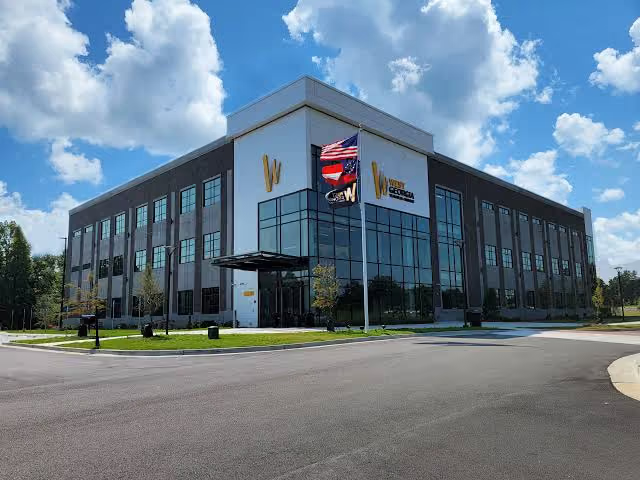
West Georgia Technical College Takes Campus Safety Seriously and Saves Lives Because Of It
See how West Georgia Technical College strengthened campus safety with a connected emergency response solution that helps staff quickly call for help, improves situational awareness, and supports faster response when seconds matter.
Read more
Education
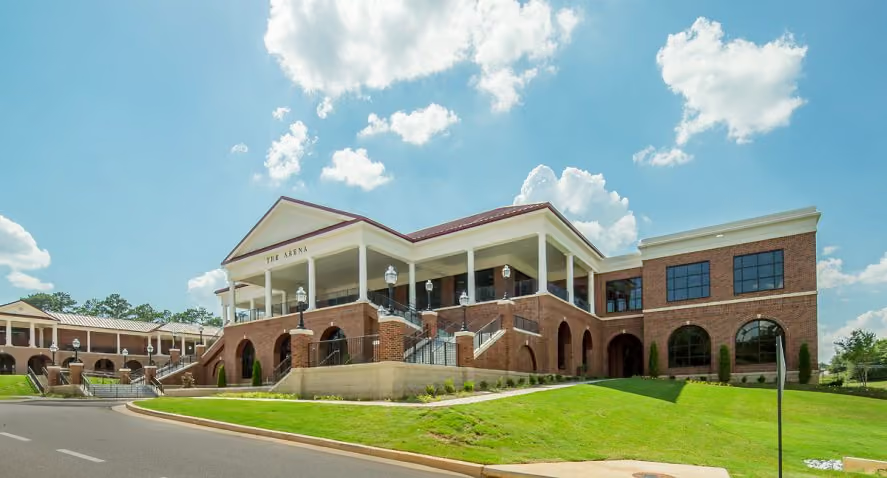
Jefferson City School District Uses CrisisAlert™ Analytics Dashboard to Improve School Climate
See how Jefferson City School District uses CrisisAlert™ analytics to gain insights into safety incidents, identify trends, and make data-informed decisions that support a safer, more positive school climate.
Read more
Education
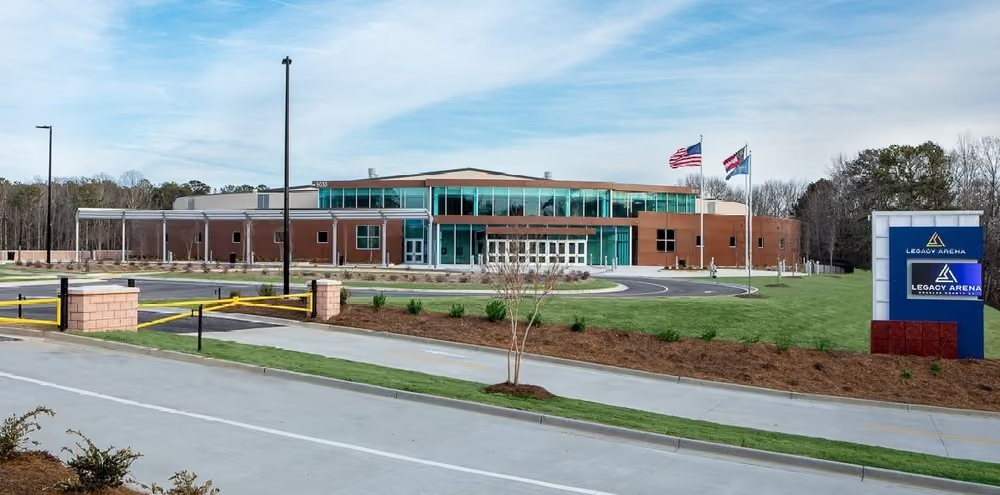
Douglas County Campus-Wide Lockdown
See how Douglas County School System used CrisisAlert™ to quickly initiate a campus-wide lockdown, notify administrators and law enforcement, and keep students and staff safe during a threatening situation.
Read more
Championing Safe Schools with Educators and Educator Associations





Built to respond first
Discover the Safety Platform
Safety solutions that prioritize speed for the best outcomes.

One-Button Ease
A wearable mobile panic button quickly and discreetly initiates alerts.

Location Accuracy
Mapping and locating capabilities provide precise location of emergencies, visitors, and safety assets.

Audio & Visual Notification
Announcements and strobe notifications make everyone aware of a campus-wide emergency.

Two-Way Messaging
Responders stay connected with continuous updates on incident type, location, and response status.

Visitor Management
A visitor management system screens and locates visitors on your campus.

Protocol Development
Plan for rapid incident response with protocols built alongside your team.

Private Managed Network
Campus-wide coverage with 100% grounds coverage and room-level location.

Integrations
Integrations to your existing safety assets to extend their capabilities.
See it for yourself
Ready to Connect with a CENTEGIX Specialist to Learn More?