
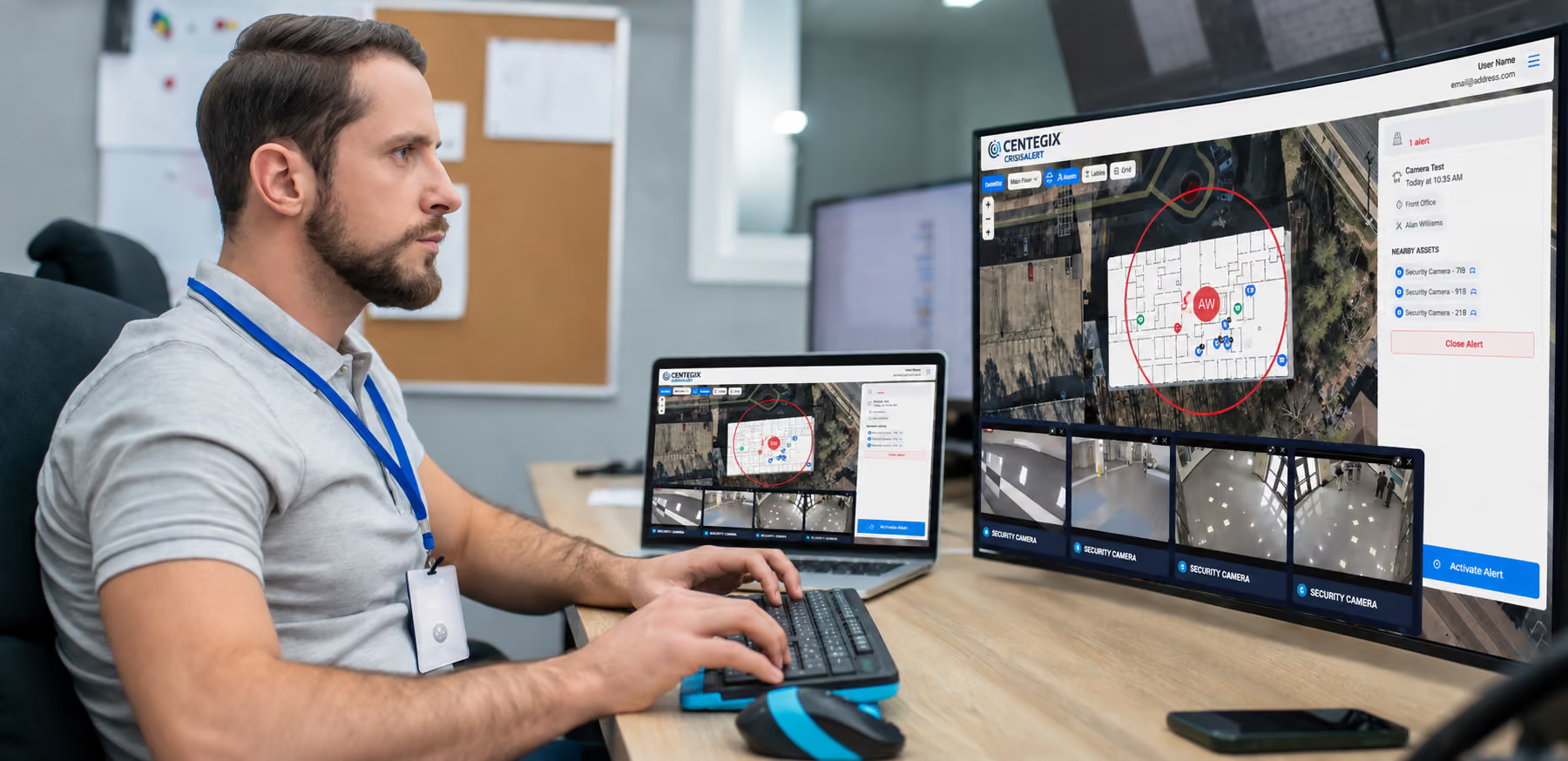
A school employee activates an emergency alert. Somewhere else on campus, a safety administrator must identify the incident location, review available information, communicate with responders, and determine what action is needed.
The district may already have technology capable of supporting each of those tasks. But what happens when the information is distributed across multiple systems that do not communicate effectively?
For school safety leaders, the next challenge is not necessarily acquiring more technology. It is ensuring existing investments work together to support faster, more coordinated emergency response.
Craig Hawkesworth, founder of FiveStones Safety and a former 12-year school board member, believes this will become an increasingly important priority for school districts.
“Districts are going to start demanding that everything work together and they work together in one single screen,” Hawkesworth told CENTEGIX CMO Robb Monkman during an episode of The Safety Signal.
His prediction reflects a broader shift in how organizations evaluate emergency preparedness: individual safety tools must contribute to a connected response.
An effective emergency management system should help organizations reduce delays, eliminate confusion, and give decision-makers access to relevant information when an incident occurs.
What Is an Integrated Emergency Management System?
An integrated emergency management system connects relevant technologies, information, and workflows to support emergency identification, communication, coordination, and response.
For school districts, these capabilities may include wearable panic buttons, emergency notifications, digital mapping, security cameras, visitor management, access control, and reunification procedures.
The objective is not simply to collect different technologies under one name. It is to ensure that the information generated by those technologies can support a coordinated response.
The Cybersecurity and Infrastructure Security Agency identifies interoperability as an important consideration in emergency communications planning.
Interoperability enables different systems or organizations to exchange and use information effectively. In emergency management, this can help responders develop a shared understanding of an incident and coordinate their actions.
The U.S. Department of Education's emergency planning guidance similarly emphasizes collaboration, defined responsibilities, and coordinated response procedures.
Technology should support those objectives.
Integration Versus Consolidation: What's the Difference?
Although the terms are sometimes used interchangeably, integration and consolidation describe different approaches.
Integration connects separate technologies so they can exchange information or support shared workflows.
Consolidation combines capabilities into fewer products or platforms.
A district may benefit from both approaches.
For example, a school might use an emergency management platform that includes alert activation, mapping, and visitor management while also integrating with an existing camera system.
That allows the district to extend the value of technology it already owns without necessarily replacing every component.
This distinction is central to Hawkesworth's vision.
He does not suggest that one provider must manufacture every safety technology a district uses. Instead, he anticipates growing demand for vendors willing to work together and deliver a more connected experience.
Why Are Disconnected School Safety Systems a Risk During Emergencies?
Fragmented safety technology can create operational challenges when personnel must gather information from several independent systems.
Consider a hypothetical emergency in which an employee activates an alert after discovering a serious incident.
A district safety administrator may need to locate the alert, identify nearby security cameras, contact appropriate personnel, and coordinate with first responders.
If these activities require navigating several unrelated interfaces, the administrator must spend additional time locating and interpreting information.
That complexity can become especially problematic during rapidly developing incidents.
Hawkesworth describes the challenges of monitoring security cameras on one screen, emergency alerts on another, access control elsewhere, and reunification information in a separate application.
His concern is that district personnel may be forced to shift attention between systems instead of concentrating on the incident.
The National Interoperability Field Operations Guide and related CISA resources address the importance of coordinated communications capabilities in emergency response.
Although these resources primarily concern public safety communications, the underlying principle is relevant to schools: critical information must be accessible and usable by the people responsible for responding.
School leaders should therefore evaluate how technology supports the complete emergency response process.
A platform that helps compress the time required to identify, notify, and respond can address operational challenges that individual products may not solve independently.
Similarly, reducing common school safety technology delays requires attention to how information moves between employees, administrators, and responders.
How Does System Integration Improve Situational Awareness?
Situational awareness is the ability to understand what is happening, where it is happening, and what information is relevant to the response.
During a school emergency, that understanding may depend on several sources.
An emergency alert can identify that assistance is needed. Location technology can help determine where the incident is occurring. Digital mapping can provide building layouts and nearby safety assets. Camera footage may offer additional visual context.
When these capabilities work together, responders can obtain a more complete picture of the situation.
The CENTEGIX Safety Platform connects multiple safety capabilities designed to support rapid incident response.
For example, CENTEGIX CrisisAlert allows employees to activate alerts through wearable badges, while CENTEGIX Safety Blueprint provides digital mapping and facility information.
These capabilities help connect an employee's request for assistance with the location information responders need.
The U.S. Department of Education's Building Blocks to School Safety toolkit emphasizes the importance of understanding school-specific conditions, resources, and responsibilities when developing emergency operations plans.
Integrated technology can help translate that planning information into practical response capabilities.
Connecting Alerts With Visual and Location Information
Location information answers an essential question: Where is help needed?
Visual information can help answer another: What is happening?
When these sources are connected, responders may be able to make better-informed decisions without manually searching for relevant camera footage.
CENTEGIX Alert Activated Video connects CrisisAlert activations with nearby compatible cameras, providing responders with real-time visual context during an incident.
This capability builds on the relationship between alert activation, location intelligence, and situational awareness.
It also demonstrates how integrations can extend the value of existing security infrastructure.
Other approaches, including AI-activated video and incident detection integrations, can support different pathways for recognizing and responding to incidents.
These technologies do not eliminate the need for human judgment. Rather, they can help responders obtain relevant information and make decisions based on the circumstances.
Why Is Unified Visibility Important for School Emergency Response?
Hawkesworth believes school districts will increasingly demand a unified view of their safety operations.
Describing his expectations for the next three to five years, he says:
“I'm going to have visibility into all of it in one single computer screen that's going to let me see everything that's going on.”
The underlying objective is straightforward: reduce the effort required to assemble relevant information during an emergency.
A unified operational view may help authorized personnel identify active alerts, understand incident locations, review connected information, and coordinate response activities.
However, unified visibility does not necessarily mean every district system must be replaced or that every function will appear in a single application.
Different technologies have different purposes, security requirements, and integration capabilities.
The practical objective is to make relevant information accessible through workflows that support the people responding.
The CISA interoperability framework offers useful principles for evaluating how organizations coordinate communications across different technologies and stakeholders.
School districts can apply a similar mindset when reviewing their safety infrastructure.
For example, digital critical incident mapping can establish a shared understanding of campus facilities and safety assets.
Connecting that information with emergency notifications and other supported systems can reduce the need to locate critical details manually.
The CENTEGIX Safety Platform already provides a central environment for several of its safety solutions and supports selected integrations. Hawkesworth's vision of comprehensive single-screen visibility across a district's broader technology ecosystem represents a future direction, not a claim that every third-party system can currently be managed from one interface.
What Should Districts Look for in an Emergency Management Platform?
As school safety technology becomes more interconnected, district leaders should evaluate platforms based on how effectively they support emergency response—not simply how many features they include.
A comprehensive evaluation should consider the district's existing infrastructure, operational requirements, emergency procedures, and available resources.
The CISA K–12 school security guidance supports a layered approach to school security planning and vulnerability assessment.
The following questions can help districts evaluate potential emergency management platforms.
Evaluation area | Questions for district leaders
Interoperability | Can the platform connect with relevant existing safety technologies?
Alert activation | Can employees request help quickly and reliably from different campus locations?
Location information | Can responders identify where an incident is occurring?
Emergency notifications | Can the system communicate appropriate information to designated personnel?
Situational awareness | Can responders access relevant mapping, video, or other incident information?
Implementation | How are systems configured, integrated, and tested?
Training and adoption | What support helps employees become confident using the technology?
Ongoing support | How does the provider maintain integrations and respond to changing district needs?
These considerations are particularly relevant for IT leaders responsible for balancing safety requirements with system reliability, cybersecurity, and operational complexity.
An effective emergency management system implementation should account for those responsibilities from the beginning.
Districts should also consider whether technology can adapt as their needs change.
For example, schools may introduce new camera systems, expand facilities, modify access control procedures, or update emergency response protocols.
A flexible platform and dependable vendor relationships can help districts manage these changes without unnecessarily complicating their safety infrastructure.
How Will School Safety Technology Evolve Over the Next Five Years?
Hawkesworth expects interoperability and unified visibility to become increasingly important purchasing considerations for school districts.
His prediction reflects a broader movement toward connected emergency management, where the value of technology depends partly on how effectively it shares information and supports coordinated action.
However, integration alone will not guarantee better emergency outcomes.
Districts will still need trained personnel, reliable alerting procedures, coordinated exercises, and ongoing evaluation.
The Department of Homeland Security's exercise starter kits provide tools for testing emergency plans and identifying operational gaps.
Similarly, FEMA's Homeland Security Exercise and Evaluation Program emphasizes continuous improvement through structured evaluation and corrective action.
These principles will remain relevant even as technology becomes more sophisticated.
Hawkesworth also emphasizes the importance of human relationships in successful technology partnerships.
Drawing on his experience with FiveStones Safety, he describes the value of hands-on implementation, in-person training, and responsive customer support.
The point is that technology providers must do more than deliver products. They must help organizations implement solutions effectively and adapt as operational requirements evolve.
This aligns with the importance of staff adoption and ongoing support in ensuring that safety technology becomes part of everyday operations.
A connected platform is most valuable when the people using it understand how to act on the information it provides.
The Future of School Safety Depends on Connected Response
School districts have more safety technology options than ever before. But adding capabilities does not automatically create a coordinated emergency response.
The next stage of school safety innovation will depend on connecting relevant technologies, reducing unnecessary complexity, and giving responders access to actionable information.
For district leaders, that means evaluating how systems work together, whether personnel can use them effectively, and how technology providers support long-term preparedness.
As Hawkesworth predicts, interoperability and unified visibility are likely to become increasingly important considerations.
The ultimate objective is not a single screen for its own sake. It is a more effective response when every second matters.
Hear Craig Hawkesworth discuss the future of connected school safety technology in Episode 11 of The Safety Signal, “Everyone Has a Plan Until…”.
Explore how the CENTEGIX Safety Platform brings together emergency alerting, mapping, video integrations, and other safety capabilities to support coordinated incident response.
Frequently Asked Questions About Integrated Emergency Management Systems
What is an integrated emergency management system?
An integrated emergency management system connects relevant technologies, information, and workflows to support emergency identification, communication, coordination, and response. In schools, this may include alerts, digital mapping, video, visitor management, and other safety capabilities.
Why is interoperability important in school safety technology?
Interoperability allows compatible systems to exchange and use information. During emergencies, this can reduce the need for personnel to gather information manually from separate systems and help responders coordinate their actions.
What is the difference between an emergency management platform and an emergency notification system?
An emergency notification system primarily communicates alerts and instructions. An emergency management platform may support a broader set of functions, including incident activation, location information, coordination, mapping, reporting, and integrations with other technologies.
How can integrated technology improve situational awareness during school emergencies?
Integrated technology can connect alerts with location information, digital maps, and other relevant sources. This helps authorized responders understand where an incident is occurring and access additional context that may inform their decisions.
What should school districts consider when selecting an emergency management system?
Districts should evaluate reliability, ease of use, interoperability, location accuracy, notification capabilities, implementation requirements, training, ongoing support, and compatibility with existing emergency procedures and technology investments.