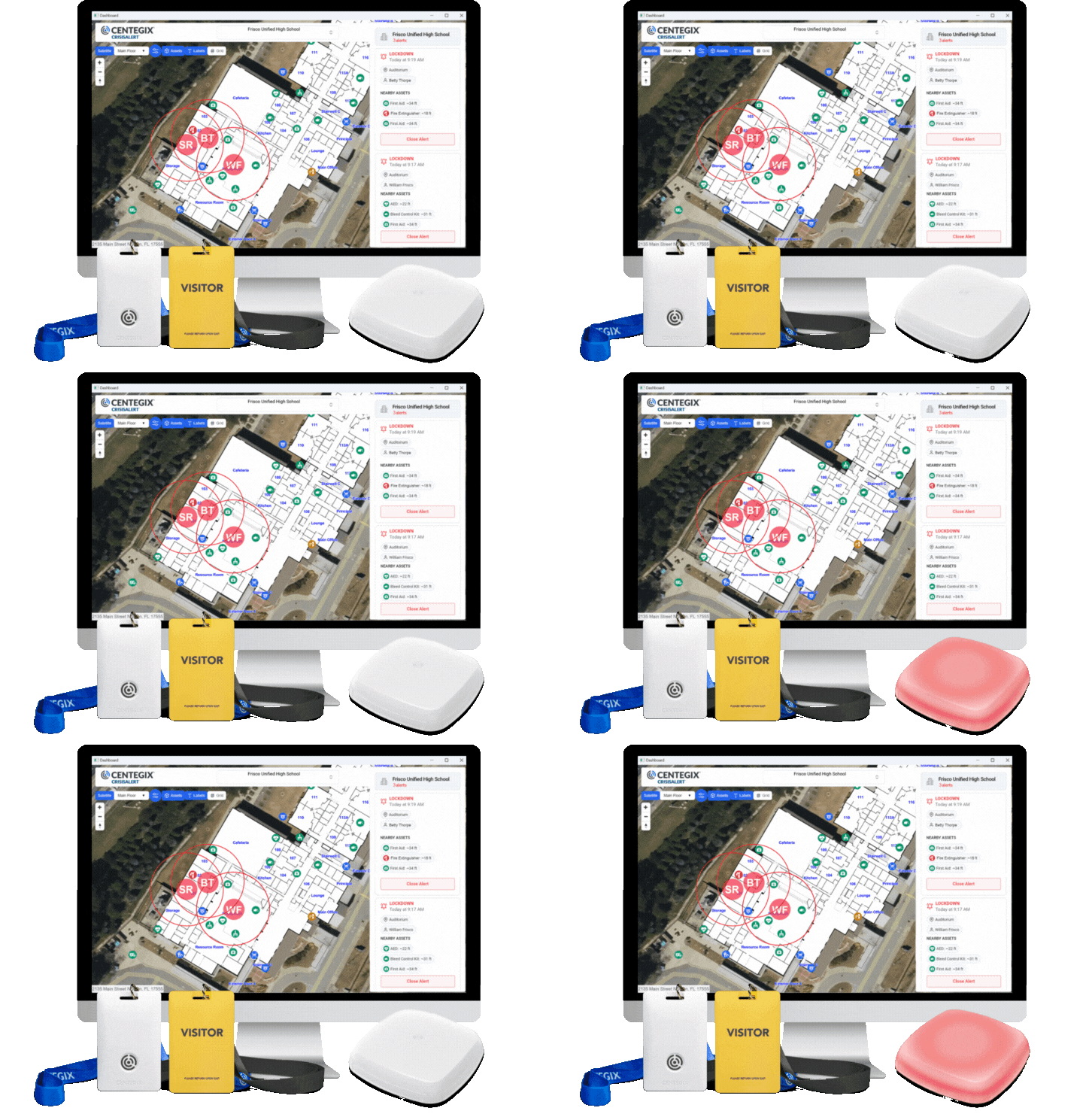
In schools, hospitals, and government facilities alike, safety mandates are on the rise. Will your emergency management system strengthen your infrastructure or strain it? In critical environments, seconds matter. And every new system introduces risk.
Compliance Looks Different in Every Environment, But IT Owns the Outcome
State and federal legislation impacts IT departments across industries. Mandates aim to increase safety, improve disaster preparedness, and mitigate violence.
- In K-12 schools throughout the US, state mandates require wearable panic buttons and rapid notification of law enforcement, as well as digital campus mapping.
- In healthcare, patient safety standards and accreditation bodies demand reliable emergency communication.
- In government, mandates require that critical infrastructure must operate through disruptions, including natural disasters, outages, or threats.
When an organization implements an emergency management system, the IT team is accountable not only for the technology but also for fulfilling legal mandates and requirements. Reliability is key. In every Instance, IT and facilities teams are responsible for ensuring:
- Reliable connectivity
- Network integrity
- Infrastructure resilience
- Continuous uptime
The Compliance Trap: When Safety Technology Adds Infrastructure Burden
Not all emergency management systems are engineered for critical environments. Many systems are not comprehensive. Several common pitfalls can arise when organizations purchase emergency management systems.
Wired Installations That Expand Network Complexity
Change occurs every time an organization installs a new system. But IT directors should investigate the details to identify costs beyond the system’s sticker price. Network expansions can substantially increase infrastructure and labor costs. Wired strobes require network drops to every room, and each drop can cost $300–$500. Network expansion may require additional switches and closet capacity, which in turn requires labor hours spent on purchasing, installing, and maintaining new infrastructure.
The costs of network expansion add up quickly:
- A school requires strobes in dozens or hundreds of classrooms and system coverage outdoors.
- A hospital’s emergency management system must provide coverage in patient rooms, stairwells, and parking structures.
- Government facilities’ systems must function in secure wings and perimeter areas.
Network expansions can delay implementation for months or years. Wired strobes require IT professionals to accompany vendors on walk-throughs and during installation, in addition to the time required to hardwire hundreds of strobes. The bidding and purchasing processes associated with new infrastructure also extend the implementation timeline.
As a result, your organization may miss critical deadlines. While your team may perform its due diligence in choosing a vendor, if implementation delays push back timelines, you may fail to meet legal requirements and mandates. Working with a vendor who provides transparent, firm timelines helps your organization achieve compliance.
Wi-Fi Dependent Badge Systems
Wi-Fi was designed for:
- Learning environments
- Clinical mobility
- Office productivity
Wi-Fi was not designed for emergency transmission in high-density or RF-complex environments. Coverage gaps that emerge in these environments can inhibit communication and system functionality. When organizations depend on Wi-Fi badges, they create a risky scenario:
- Wi-Fi becomes the carrier for emergency alerts
- Coverage gaps in production networks become safety gaps
- Changes to Wi-Fi architecture now require safety consultation
Coverage That Can’t Be Continuously Verified
Some emergency management systems use Bluetooth-only locating devices that require a nearby badge to verify status. If no one is near the device:
- The system may not know if coverage exists
- Gaps may go undetected
- Reliability may only be confirmed during an actual emergency
- Unverified coverage becomes operational risk
A system’s components should communicate directly and constantly. Without regular communication, IT professionals cannot verify that badges are functioning properly.
Emergency management system legislation often requires that a system facilitate direct communication with law enforcement. If your system is not fully operational or does not provide continuous coverage by the established deadline, your organization is out of compliance. When legal mandates require a direct link to local law enforcement, your system should be fully functional and provide reliable campus-wide coverage by the date required.
Engineering for Speed Without Disrupting Infrastructure
Modern safety platforms must eliminate delays without adding complexity. The CENTEGIX Safety Platform® is engineered differently.
Independent Badge Transmission
CENTEGIX CrisisAlert™ wearable badges transmit alerts via a private LoRa network. The system is not dependent on Wi-Fi coverage for alert transmission, protecting wireless environments while adding minimal traffic to the network. In addition, the Safety Platform’s private networks reduce strain on existing infrastructure.
Wireless Strobes and Locating Beacons
The Safety Platform includes wireless strobes and locating beacons, preventing the large-scale network expansions that other emergency management systems often require.
Safety Platform:
- Utilizes LoRa and Bluetooth in its wireless strobes
- Eliminates the need for a network drop for each device
- Prevents costly cabling projects
- Reduces installation time
- Minimizes the need for facilities coordination
- Eliminates the need for network expansion
The efficiency with which the Safety Platform can be installed and implemented improves organizational safety. The sooner an organization can fully implement its emergency management system, the sooner it can develop protocols, train personnel, and reap the benefits of a comprehensive safety system.
Continuous Coverage Validation
Unlike Bluetooth-only systems, CENTEGIX® strobes and beacons regularly communicate directly with gateways via LoRa. As a result:
- Coverage gaps can be detected proactively
- Organizations do not have to rely on someone being near devices to verify status
- Validation is continuous
IT directors can rest assured that their systems and all components are working around the clock. And when a badge or strobe is not functioning properly, the system communicates this information. The Safety Platform’s data validation is continuous, not conditional.
Redundancy Built for Infrastructure Failure
IT departments work hard to achieve compliance. But even a fully compliant system is worth little if it fails during a network outage. CENTEGIX technology is designed to provide redundancy and protect organizations even when its network is down. In schools, hospitals, and government facilities, redundancy isn’t optional; it’s expected.
The Safety Platform connects to an organization’s existing network for normal data transmission. The CENTEGIX system also includes tri-carrier cellular backup via T-Mobile, Verizon, and AT&T. The Safety Platform automatically uses the strongest available signal, providing redundancy without forcing organizations to rely on a single carrier.
Clarity Across the Entire Organization
The CENTEGIX emergency management system was purpose-built to replace chaos with coordination. The Safety Platform provides clear, effective notifications across an organization’s entire campus. Multi-sensory alerts include:
- Visual strobes
- On-screen notifications
- Intercom integrations
Clarity eliminates confusion. When an alert is triggered:
- Staff know what is happening
- Responders know where to go
- Leadership has immediate situational awareness
Compliance Should Strengthen Infrastructure, Not Strain It
IT leaders consistently face the same concern: every device added to a facility introduces potential risk. The safest solution:
- Minimizes dependency on existing Wi-Fi
- Reduces wiring and physical infrastructure expansion
- Continuously validates coverage
- Includes redundant communication paths
- Simplifies implementation
The complexity of any emergency management system should exist on the engineering side. On the customer’s side, the system should be as simple as possible to install and implement. If a system’s complexity prevents people from using it, it becomes an added distraction instead of creating added value. The CENTEGIX Safety Platform delivers a meaningful return on investment and fosters a culture of safety.
Education, healthcare, and government organizations all face increasing compliance requirements and deadlines. But mandates should not force organizations to choose:
- Speed versus stability
- Visibility versus cost
- Compliance versus infrastructure risk
The CENTEGIX Safety Platform is a purpose-built, reliable safety solution that eliminates safety gaps, provides clarity in emergencies, and eliminates delays. CENTEGIX technology empowers IT professionals to create safe environments while meeting safety mandates.
To learn more about how the CENTEGIX Safety Platform emergency management system can become the center of your organization’s culture of safety, schedule a demo today.