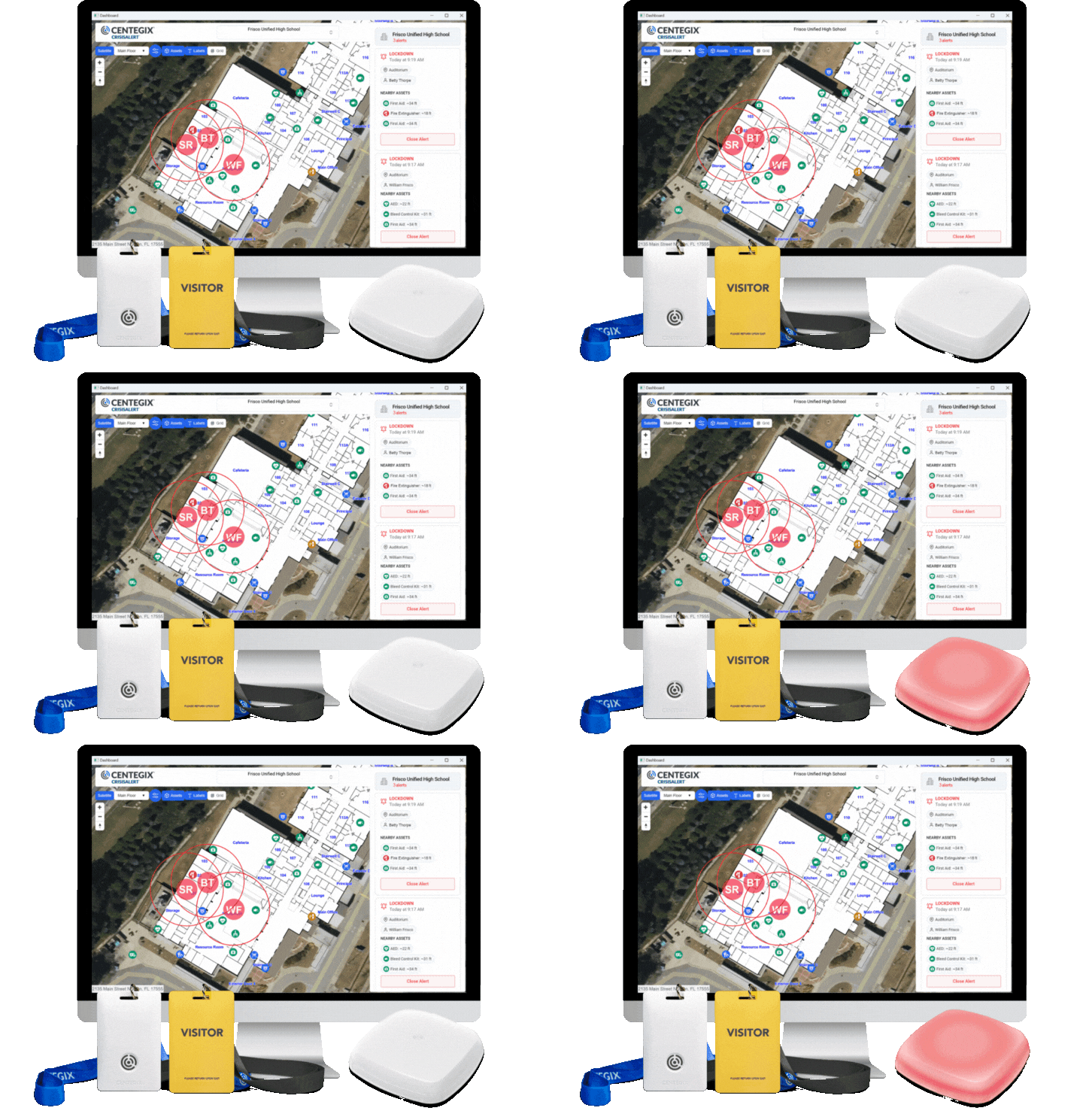
K-12 digital mapping legislation sets a clear baseline: 911 must have access to school maps. Floor plans. AED locations. Ingress and egress points. That is the law, and it matters.
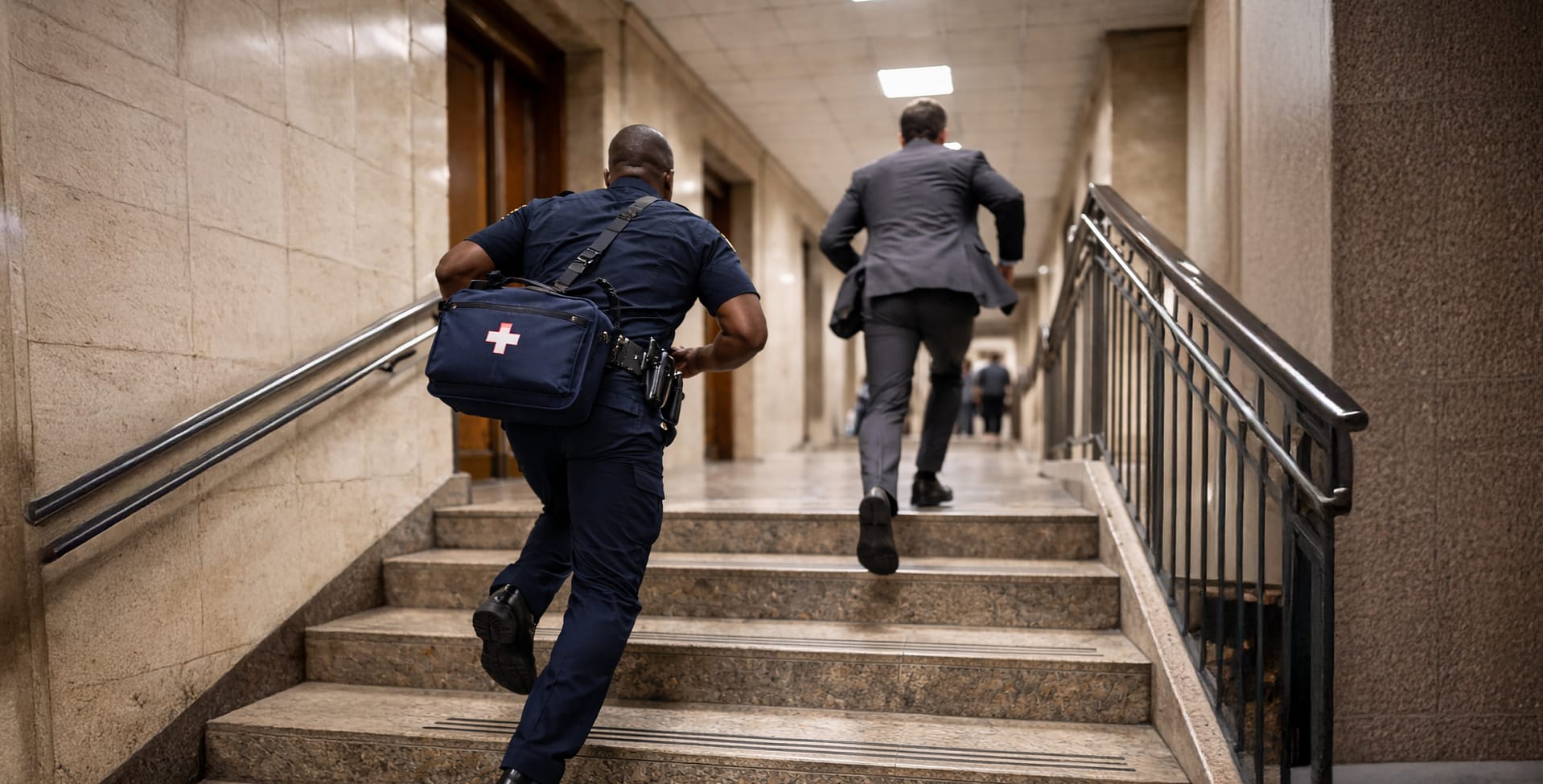
But here is the question the law does not fully answer: what about the principal? The school nurse? The teacher who heard something in the hallway and is already moving toward it?
The average outside response time to a 911 call is 4 to 5 minutes. In a medical emergency requiring an AED, that window is everything, and the person who reaches it first won’t be a first responder. It will be a teacher, or the school resource officer, someone already in the building. Does your mapping solution work for them?
That is the question Safety Blueprint was built to answer. And it is the distinction that separates a solution that meets compliance from one that positions people to save lives.
Compliance is the floor. Practicality is the point.
Most states model their K-12 digital mapping legislation around a consistent set of requirements. A compliant solution must deliver on all of them. Safety Blueprint meets every one, and in several areas goes well beyond what the law currently requires.
We did not build Safety Blueprint to pass a checklist. The standard reflects what genuinely capable solutions have always delivered. We helped set the benchmark that others are still working toward.
“We provide the information to the people that will actually be able to save the most lives, the people onsite who are running down the hall in seconds.” Brent Cobb, CEO, CENTEGIX
The full compliance picture, requirement by requirement
Here is exactly how Safety Blueprint performs against every K-12 digital mapping legislative requirement, and where it goes further than the law currently asks.
| Requirement | What the law requires | How Safety Blueprint delivers | Status |
| Digital format | Maps must be accessible digitally. No paper-based only solutions. | Safety Blueprint is a digital mapping tool with real-time access to individual floor plans, aerial imagery, labeling, assets, exit routes, and more. | ✓ Met |
| GIS-compatible | Use of industry-standard geospatial data formats. | Safety Blueprint supports export in GIS-compatible formats, including CSV (for points), DXF (for floor plans), and PDF maps. Direct access is also provided through the CENTEGIX Maps API. | ✓ Met |
| Gridded, tactical overlay | Gridded, tactical overlay and a printable format. | Safety Blueprint has a gridded overlay option with an on/off user-enabled toggle. The overlay is sized based on the scale of the underlying property size/map and prints when the map is printed. | ✓ Met |
| Layered content | Includes floor plans, ingress/egress points, room numbers, hallways, stairwells, and utility control points. | Safety Blueprint provides more layered content than any other digital mapping solution for K-12 schools, including user-editing capabilities for walls, objects, labels, and utility assets. | ✓ Exceeds |
| Emergency asset tagging | Fire extinguishers, AEDs, trauma kits, and gas/electrical shut-offs must be clearly marked. | Safety Blueprint provides more emergency asset tagging functions than any other digital mapping solution. Schools can configure fields and update them in real-time with pictures, x-y coordinates, and inventory across 100+ safety asset types. | ✓ Exceeds |
| True north orientation and x-y coordinates | Ensures alignment with first responder systems. | Safety Blueprint maps are oriented true north with x-y coordinates and include a verified floor level for the z axis. | ✓ Met |
| Physical walk-through verification | Physical site walk-through verified by the entity producing the data for accuracy. | CENTEGIX install teams conduct on-site walk-throughs, both inside and outside, to place devices, label rooms, and tag assets. A large field services team performs year-round on-site services, ensuring maps stay current. | ✓ Exceeds |
| Metadata and version control | Maps must include version number, update logs, and authorship. | Safety Blueprint maps are updated by role-based customer personnel and provided to PSAP/RTCC tools in real-time. Update logs are available for auditing. | ✓ Exceeds |
| Update capability | Districts must be able to revise and publish new versions as buildings change. | Safety Blueprint can be updated by customers directly in real-time, or customers can request changes from CENTEGIX mapping resources. | ✓ Met |
| No additional software required | Maps must not require additional software to view. | Safety Blueprint provides a universal PDF file type. Direct integrations with CAD systems (RapidDeploy, SaferWatch) and RTCC platforms (Motorola CCA) pull data from Safety Blueprint in real-time. | ✓ Met |
| Compatible with existing 911 platforms | Maps must integrate with existing 911 CAD/EMS platforms. | Safety Blueprint maps can be leveraged directly in the PSAP/RTCC at no cost and provides real-time API capability to FususONE, Motorola CCA, RapidDeploy, SaferWatch, and others. | ✓ Met |
| Data stored in the United States | Data must be collected, produced, and stored exclusively within the United States. | CENTEGIX utilizes US-based infrastructure, ensuring all customer data is collected, produced, and stored exclusively within the United States. | ✓ Met |
What first responders actually rely on
Legislation is written around 911. That makes sense. But in a real emergency, information needs to reach everyone: the principal, the nurse, the SRO, the teacher. It needs to be on the devices they already carry, in a format they can use under pressure, and it needs to be current.
Safety Blueprint puts maps directly in the hands of people already in the building. Role-based access means the right people see what they need. Real-time updates mean the map reflects the school as it exists today, not as it was documented 18 months ago.
And when outside agencies do arrive, Safety Blueprint integrates directly with the platforms they already use: FususONE, Motorola CCA, RapidDeploy, SaferWatch, and others. The data is already there. Already current. Already in their system.
What to ask any vendor, including us
We built Safety Blueprint to set the benchmark and we hold ourselves to it. We encourage every district evaluating any mapping solution, including ours, to ask: does this solution work for the people already in the building, not just the people arriving four minutes later?
Our full compliance matrix is publicly available. Every requirement is documented. We would rather earn your trust through transparency than ask you to take our word for it.
Because the law sets the floor. Safety Blueprint is built for what happens above it.
Download the compliance matrix | Request a live compliance walkthrough