
Protect Healthcare Workers. Strengthen Workplace Safety. Improve Incident Response.
CENTEGIX helps healthcare organizations create safer environments through rapid incident response technology that empowers staff to get help immediately and enables teams to respond faster during emergencies.
Protect Healthcare Workers. Strengthen Workplace Safety. Improve Incident Response.

Want to Stay in the Know?
Join our email list and be the first to hear about all things healthcare safety—including blogs, new reports, and more.
"*" indicates required fields
Healthcare Workers are Concerned About Their Safety
Despite ongoing efforts to prevent workplace violence, workers continue to have ongoing personal safety concerns, often driven through first-hand experience.
What Workplace Violence Prevention Looks Like Today
Modern workplace violence prevention requires more than policies alone. Leading healthcare organizations combine:
Prevention
Training, awareness, reporting, and risk identification.
Preparedness
Clear response protocols and coordinated communication.
Response
Technology that enables staff to quickly summon assistance during escalating situations.
Continuous Improvement
Data, reporting, and insights that strengthen safety programs over time.
CENTEGIX supports healthcare organizations throughout each stage of this approach.
2026 Healthcare Trends Report
Explore the challenges leaders tackled in 2025 and the action needed for success in 2026 to stabilize the healthcare workforce and build organizational resilience.
Resources for Healthcare Workplace Violence Prevention
Violence in Healthcare Statistics
Explore the latest data and trends impacting healthcare workers.
Healthcare Funding Opportunities Guide
Funding options to support a safer environment for teams and patients.
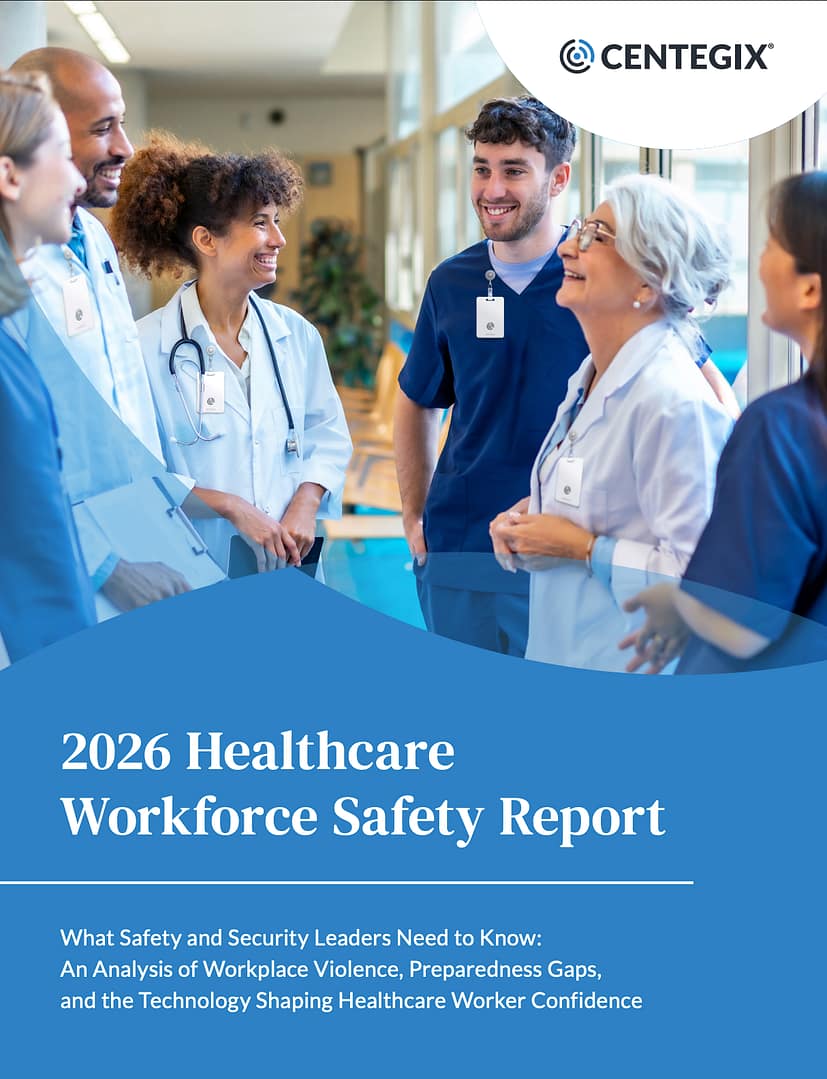
2026 Workforce Safety Survey Report
Insights from 600+ healthcare workers on safety, preparedness, and tech in violence prevention.

The Financial Impact of Violence in Healthcare
$18.27B
Estimated annual violence-related costs to hospitals in 2023¹
$5.8M
Lack of retention can cost an average hospital up to $5.8M per year⁴
14%
Increase in inpatient mortality associated with a 10% rise in nurse intent-to-leave³
Yet, the American Hospital Association estimates nearly 80% of violence-related spend is tied to reactive costs—including staffing disruption, injury care, legal expenses, and operational recovery—rather than proactive prevention efforts.¹
Investing in safety can reverse these trends, improving employee well-being, retention, productivity, and patient care.

Improved work environments can improve nurse satisfaction and burnout by 28–32%.³

Every one-point change in RN turnover can save a hospital $289K annually⁴

Investing in workplace safety measures can reduce incidents of violence by up to 66%
How CENTEGIX Protects Healthcare Staff
Accelerating Emergency Response When Help Is Needed Most
With CENTEGIX Safety Platform®, staff can discreetly signal for help from anywhere on campus (indoors and outdoors) with a single button on a wearable duress badge.
When an alert is activated, security teams and responders receive precise location information showing who needs help on a detailed map. This streamlines and accelerates incident response to promote de-escalation and optimize outcomes.

Speed
Immediate notification and precise location information facilitate the fastest response

Clarity
Interoperability and customized response protocols replace chaos with coordination

Coverage
Every staff member can signal for help—anytime, anywhere on campus

Intel
Data-driven insights improve planning, training, and readiness
Did You Know?
68% of healthcare workers prefer a duress button that only shares their location when they trigger an alert for help, versus continuously tracking them throughout their day.
Unlike RTLS devices that continuously track staff throughout their shift, CENTEGIX locating abilities are only activated when a user triggers an alert from their badge, preserving privacy and increasing adoption.
Explore the Healthcare Safety Solutions of the CENTEGIX Safety Platform
CENTEGIX CrisisAlert™ for Healthcare
Wherever your healthcare workers are—in patient rooms, emergency bays, or even in the parking garage—give them peace of mind with one button.
CrisisAlert is a wearable duress button that empowers healthcare staff to get help discreetly, when and where they need it, anywhere on your campus.
CENTEGIX Safety Blueprint® for Healthcare
Digital maps of your facilities—including every floor of every building—are a critical part of your healthcare safety plan.
Safety Blueprint, our dynamic digital mapping solution, ensures responders know the precise location help is needed, and can access safety assets quickly.
CENTEGIX Visitor Management for Healthcare
Numerous visitors—caregivers, family members, contractors, visiting staff—come to your facility every day. Our visitor management system screens and checks in all visitors before they enter your facilities, giving you and your staff assurance that the people they encounter on campus are permitted to be there.

Why Healthcare Organizations Choose CENTEGIX
Healthcare leaders choose CENTEGIX because they need more than a safety device. They need a partner that helps them:
→ Improve staff confidence
→ Support workforce retention
→ Strengthen emergency response
→ Elevate workplace violence prevention efforts
→ Promote a culture of safety
Together, we can create safer workplaces where employees feel supported and protected.
We can’t always prevent workplace violence, but we can mitigate its effects—and CENTEGIX will help us do that.
I think workplace safety has improved tremendously. Having CENTEGIX has made it so there is an efficient way to reach out if you have a situation escalating that you need immediate help with.
A lot of people may never need to use it. But if they do need to use it, they’re really glad it’s available.
Build a Safer Environment for Healthcare Workers
See how healthcare organizations are strengthening workplace violence prevention efforts and improving emergency response with CENTEGIX.
Talk with a Healthcare Safety Expert.

"*" indicates required fields
*By providing my phone number to CENTEGIX, I agree and acknowledge that CENTEGIX may send text messages to my wireless phone number for any purpose. Message and data rates may apply. CENTEGIX will only send one SMS as a reply, and I will be able to Opt-out by replying “STOP”. **No mobile information will be shared with third parties/affiliates for marketing/promotional purposes.*
Frequently Asked Questions
How does workplace violence affect healthcare organizations?
Workplace violence impacts more than just safety. It contributes to staff turnover, burnout, decreased workforce engagement, financial losses, and negatively impacts patient care.
Studies show that by strengthening workplace violence prevention, organizations can decrease incidents of violence, improve employee well-being and engagement, strengthen retention, and elevate patient care.
Why is workplace violence a growing concern in healthcare?
Healthcare workers experience workplace violence at significantly higher rates than many other professions. Incidents involving patients, visitors, and others can impact employee well-being, retention, patient care, and operational performance. As a result, healthcare organizations are increasingly investing in prevention strategies that help protect staff and improve emergency response.
How can healthcare organizations improve workplace violence prevention?
Effective workplace violence prevention combines training, reporting, response protocols, leadership engagement, and technology that enables staff to quickly summon support during emergencies.
Who should be involved in workplace violence prevention efforts?
Workplace violence prevention requires a multidisciplinary approach. Healthcare leaders increasingly recognize that safety cannot be owned by a single department.
- Effective workplace violence prevention teams often include:
- Security and emergency management
- Nursing leadership
- Physicians and frontline caregivers
- Human resources
- Risk management
- Behavioral health specialists
- Legal and compliance teams
- Communications leaders
Frontline employees play a particularly important role because they often identify operational vulnerabilities and emerging risks before leadership becomes aware of them. Organizations that foster shared accountability for safety are often better positioned to identify concerns early and implement meaningful improvements.
How can healthcare workers quickly get help during an emergency?
Healthcare workers need simple, reliable ways to request assistance when emergencies occur. Many organizations implement wearable duress buttons, emergency notification systems, and standardized response protocols to help staff discreetly alert responders and accelerate emergency response.
Why is response time important during workplace violence incidents?
Many workplace violence incidents escalate over time. Faster response can help de-escalate situations, support staff, reduce severity of injuries, and improve overall outcomes. The ability to quickly summon assistance is often a critical component of workplace violence prevention strategies.
What role does technology play in workplace violence prevention?
Technology helps organizations improve communication, accelerate response times, support incident management, and strengthen overall safety programs.
What technologies help improve healthcare worker safety?
Technology plays an important role in helping healthcare organizations accelerate response during emergencies and workplace violence incidents.
Examples include:
- Wearable duress buttons and panic alert systems
- Incident reporting and analytics tools
- Digital incident and asset mapping
- Visitor management systems
- Emergency notification platforms
- Behavioral threat assessment tools
- Real-time communication solutions
A recent survey found that wearable duress buttons are the #1 technology healthcare workers say makes them feel safer. Many healthcare organizations use a combination of wearable duress buttons, digital incident and asset mapping, visitor management tools, and incident reporting solutions as part of a comprehensive workplace violence prevention strategy.
What is a wearable panic button?
A wearable panic button is a technology that allows frontline workers to signal for help anywhere, without needing a phone, app, static wall button, etc to get help.
These are particularly helpful for healthcare workers who are always on the move versus seated at a desk or an isolated spot. Some buttons even offer campus-wide coverage so they can signal for help no matter where they are on campus, inside or outside. Explore the CENTEGIX CrisisAlert wearable duress button.
How does a wearable panic button work?
A wearable duress button or panic button enables staff to discreetly request assistance and share their location with responders during an emergency or escalating situation.
What should healthcare leaders look for in a wearable duress button solution?
Healthcare leaders often evaluate:
- Ease of use during high-stress situations
- Response speed
- Campus-wide coverage
- Reliability
- Scalability
- Integration capabilities
- Employee adoption
- Privacy considerations
Solutions that are intuitive and trusted by staff are often more likely to be used consistently when assistance is needed.
Do all panic buttons use RTLS?
No, but most do. While CENTEGIX can pinpoint the exact location of a person needing help, locating abilities are only activated by the user, when they activate an alert using the button on their badge. This empowers them with control, preserves their privacy, and encourages adoption.
How does workplace violence impact healthcare organizations financially?
Violence-related incidents can contribute to employee turnover, workers’ compensation claims, lost productivity, absenteeism, legal expenses, and operational disruption. Many organizations evaluate workplace violence prevention investments as part of broader workforce and operational improvement initiatives.
Are workplace violence prevention programs worth the investment?
Many healthcare organizations view workplace violence prevention as a strategic investment in workforce stability, employee well-being, and organizational resilience.
As workplace violence continues to impact staff retention, burnout, and operational performance, prevention efforts are increasingly being evaluated alongside other initiatives that support workforce preservation and quality care delivery.
While every organization’s needs differ, healthcare leaders are increasingly recognizing that the cost of violence often extends beyond individual incidents and can affect staffing, patient care, morale, and financial performance across the organization.
How can healthcare leaders justify workplace safety investments?
Many healthcare organizations build business cases by evaluating incident trends, turnover costs, injury claims, workforce satisfaction, and operational impacts. By connecting safety initiatives to workforce stability, organizational resilience, and financial performance, leaders can better quantify the value of prevention efforts.
The CENTEGIX ROI Calculator and Workplace Safety ROI Report, provides a robust, evidence-based framework to help you model the financial value of investing in a comprehensive safety program. Learn More.
Why is workplace violence prevention important for employee retention?
Workplace safety has become an increasingly important factor in employee satisfaction and retention. Healthcare workers who experience violence or feel unsafe at work are more likely to experience burnout, disengagement, anxiety, and turnover.
In contrast, organizations that invest in safety initiatives often strengthen perceptions of organizational support and workforce well-being. Creating a safer work environment can help healthcare organizations improve retention, reduce turnover-related costs, and better support the employees who deliver patient care every day.
SOLUTIONS
INDUSTRIES
RESOURCES
COMPANY
PARTNERS
CONTACT
EVERY. SECOND. MATTERS.®