
CENTEGIX® | Education
Utah School Safety Standards
CENTEGIX® | Education
Utah School Safety Standards

CENTEGIX Webinar
Utah Alyssa’s Law Compliant – USBE Approved: Protecting Your District with CENTEGIX® CrisisAlert™ at Zero Cost
Learn how Utah school districts can use available state funding to get an Alyssa’s Law-compliant and USBE-approved solution through USBE-CC26055-RFP. This 30-minute briefing will cover what sets CENTEGIX apart as a trusted safety partner across more than 18,000 locations with a 99% customer retention rate, what to expect during implementation, and the next steps for your district. The session will conclude with live Q&A. Choose from four sessions on August 7, 14, 21, and 28, 2026.
CENTEGIX Tops Approved Vendors for Alyssa’s Law in Utah
CENTEGIX is a USBE-approved vendor for Alyssa’s Law in Utah, giving districts a trusted, procurement-ready path to compliance with state-mandated emergency alerting requirements. Following a comprehensive, competitive evaluation conducted by the Utah State Board of Education, CENTEGIX earned the highest overall score among all evaluated providers, outperforming national competitors based on technical merit, value, and alignment with Utah’s safety priorities.
The Evaluation Committee determined that CENTEGIX delivers the best overall value to Utah schools, meeting all minimum criteria, offering reasonable pricing within budget, and demonstrating a solution purpose-built to support rapid incident response and educator safety. For Utah districts seeking a compliant, state-approved solution that has already been vetted and validated at the highest level, CENTEGIX provides confidence, clarity, and immediate readiness.
Districts must submit their vendor selection by 5:00 p.m. on Friday, September 18, 2026.
All LEAs must complete the FY27 Wearable Panic Alert Device Request Form (Qualtrics) by the due date to indicate their level of participation in this program.
Alyssa’s Law Passes in Utah: Part of House Bill 84
Alyssa’s Law in Utah was signed into law by Governor Spencer Cox and authored by Sen. Don Ipson and Rep. Ryan Wilcox. This legislation, included as part of the Utah’s largest school safety measure, H.B. 84, requires Utah public and charter schools to “provide a staff person in each classroom with a wearable panic alert device that allows for immediate contact with emergency services or emergency services agencies, law enforcement agencies, health departments, and fire departments.”
Alyssa’s Law is named for Alyssa Alhadeff, a victim of the 2018 Marjory Stoneman Douglas High School shooting, and has been championed by Alyssa’s parents, Lori and Dr. Ilan Alhadeff. Alyssa’s Law has garnered support across the political spectrum as a common-sense solution for school safety.
The new law requires schools to adopt emergency communications systems such as CrisisAlert™—part of the CENTEGIX Safety Platform®—a rapid incident response solution that helps protect students and staff members by empowering teachers and staff to immediately get help with a discreet panic button on a wearable badge. CrisisAlert operates via a private network, the ideal solution for schools where gaps in Wi-Fi and poor cellular signals can often disrupt connectivity. With intelligent response mapping and campus-wide notification capabilities, CrisisAlert can simultaneously send a school into lockdown while immediately providing first responders with exact location information, enabling them to respond faster in an emergency situation.
In addition to emergency communication systems, H.B. 84 also mandates:
School safety incident and data reporting requirements
Additional school safety requirements
Ready to Connect with a CENTEGIX Specialist to Learn More?

"*" indicates required fields
*By providing my phone number to CENTEGIX, I agree and acknowledge that CENTEGIX may send text messages to my wireless phone number for any purpose. Message and data rates may apply. CENTEGIX will only send one SMS as a reply, and I will be able to Opt-out by replying “STOP”. **No mobile information will be shared with third parties/affiliates for marketing/promotional purposes.*
Ready to Connect with a CENTEGIX Specialist to Learn More?
"*" indicates required fields
*By providing my phone number to CENTEGIX, I agree and acknowledge that CENTEGIX may send text messages to my wireless phone number for any purpose. Message and data rates may apply. CENTEGIX will only send one SMS as a reply, and I will be able to Opt-out by replying “STOP”. **No mobile information will be shared with third parties/affiliates for marketing/promotional purposes.*
School safety incident and data reporting requirements
Additional school safety requirements
Frequently Asked Questions About Utah’s Alyssa’s Law
What must Utah schools do to comply with Alyssa’s Law?
Under Utah Code Section 53G-8-805, Utah public school districts and charter schools must provide the lead teacher in each classroom with a wearable panic alert device that communicates directly with the appropriate Public Safety Answering Point, or PSAP. LEAs must also ensure that school building personnel receive training on the protocol and proper use of the devices before the school year begins.
Compliance involves more than purchasing panic buttons. District leaders should evaluate whether a solution can reliably connect staff with help, identify precisely where an emergency is occurring, support coordination with first responders, and function throughout the entire campus. The Utah School Safety Playbook provides additional guidance on Utah’s wearable panic alert device requirements and other school safety responsibilities established through H.B. 84.
How can Utah LEAs obtain state-funded wearable panic alert devices for FY27?
The Utah State Legislature has allocated funding to help public K–12 LEAs obtain wearable panic alert devices through USBE’s approved cooperative contracts. To participate, each LEA must complete the FY27 Wearable Panic Alert Device Request Form and select an approved contractor by 5:00 p.m. on Friday, September 18, 2026.
According to the USBE Wearable Panic Alert Devices program page, state funding covers Tier 1 service costs for requests approved by the Utah School Safety Center. Devices or services acquired before formal approval, including previously purchased wearable panic alert devices, are not eligible for reimbursement.
Is CENTEGIX an approved wearable panic alert device provider for Utah schools?
Yes. CENTEGIX is a USBE-approved wearable panic alert device provider, giving Utah LEAs a state-vetted, procurement-ready option for meeting the state’s emergency alerting requirements. District leaders can review CENTEGIX’s cooperative contract and other official program information on the USBE Wearable Panic Alert Devices page.
During USBE’s competitive evaluation, CENTEGIX received the highest overall score among the evaluated providers. The Evaluation Committee determined that CENTEGIX offered the best overall value based on its technical response, reasonable pricing, fulfillment of the required criteria, and alignment with Utah’s school safety priorities.
Why should a Utah school district consider more than minimum Alyssa’s Law compliance?
A wearable panic button initiates a request for help, but the response system surrounding that device determines how quickly the right people receive useful information and act. The CENTEGIX Safety Platform connects wearable alerting with precise location information, dynamic digital mapping, campus-wide notifications, existing safety systems, and first-responder coordination.
This connected approach helps reduce the time required to identify an emergency, notify the right people, and deliver an informed response. Instead of receiving only a general alert from a school, responders can receive actionable information about where an incident is occurring, including the building, floor, and room, and identify nearby safety assets that may support their response.
How does CENTEGIX CrisisAlert connect school staff with first responders?
With the CENTEGIX CrisisAlert wearable panic button, a staff member can discreetly request help without locating a phone, opening an application, or leaving the people in their care. Depending on the type of alert, CrisisAlert can notify designated onsite responders or initiate a campus-wide emergency response.
For emergencies requiring outside assistance, CrisisAlert supports integration with the appropriate PSAP and delivers precise floor- and room-level location information to first responders. CENTEGIX Safety Blueprint provides dynamic digital maps that give responders greater situational awareness. Audiovisual notifications, including strobes, intercom announcements, and screen takeovers messages, can also alert people across the campus that an emergency is happening and to take immediate protective action.
Will CENTEGIX CrisisAlert work where Wi-Fi or cellular service is unreliable?
Yes. CrisisAlert and the Safety Platform operate over private, managed LoRaWAN networks. The system does not depend on a staff member’s cellphone, a mobile application, school Wi-Fi, or consistent cellular coverage to send an alert.
This architecture helps provide coverage throughout indoor and outdoor campus areas, including classrooms, hallways, playgrounds, athletic fields, parking lots, multi-building facilities, and other places that may have bad cell service or spotty Wi-Fi. CrisisAlert badges also have a battery life of more than one year and do not require daily charging. During implementation, the CENTEGIX team installs and tests the system and campus coverage before launch.
Does every school employee need a wearable panic alert badge?
Utah law establishes a minimum requirement to provide the lead teacher in each classroom with a wearable panic alert device. CENTEGIX believes protection should extend beyond the statutory minimum because emergencies can happen anywhere and may happen to or be witnessed first by a substitute teacher, administrator, custodian, counselor, coach, bus driver, or support staff member.
Providing a CrisisAlert wearable badge to every staff member creates greater safety equity and turns every employee into an empowered participant in the school’s response plan. It also expands a district’s ability to respond quickly to medical emergencies, student altercations, elopement, behavioral crises, and other everyday incidents, as well as campus-wide threats.
USBE’s FY27 request-form guidance states that approved contractors have agreed to supply wearable panic alert devices to all on-campus staff, including administrators, lead teachers, school safety personnel, substitute teachers, and support personnel.
How can a Utah LEA select CENTEGIX and begin implementation?
Utah LEAs interested in the state-funded FY27 program should first schedule a consultation or customized demonstration with CENTEGIX to review their schools, staffing, current safety infrastructure, and implementation needs. The LEA must then select CENTEGIX on the USBE FY27 Wearable Panic Alert Device Request Form and submit the form by 5:00 p.m. on September 18, 2026.
Following state approval, CENTEGIX will coordinate the district’s implementation. CENTEGIX will handle system configuration, installation and testing, PSAP coordination, and responder and staff training before the system goes live. Districts also receive ongoing support for as long as they remain CENTEGIX customers.
Ready to take the next step?
CENTEGIX | Playbook
Utah’s Alyssa’s Law Playbook: The What, Why, and How for Utah Schools
In March 2024, Utah passed Alyssa’s Law, requiring Utah public and charter schools to “provide a staff person in each classroom with a wearable panic alert device that allows for immediate contact with emergency services or emergency services agencies, law enforcement agencies, health departments, and fire departments.”
It went into effect May 1, 2024.
Learn about this important legislation, how it helps make schools safer, and how Utah Schools can meet and exceed compliance in our Alyssa’s Law Playbook. Download your copy today.

Find Funding for Utah School Safety Solutions
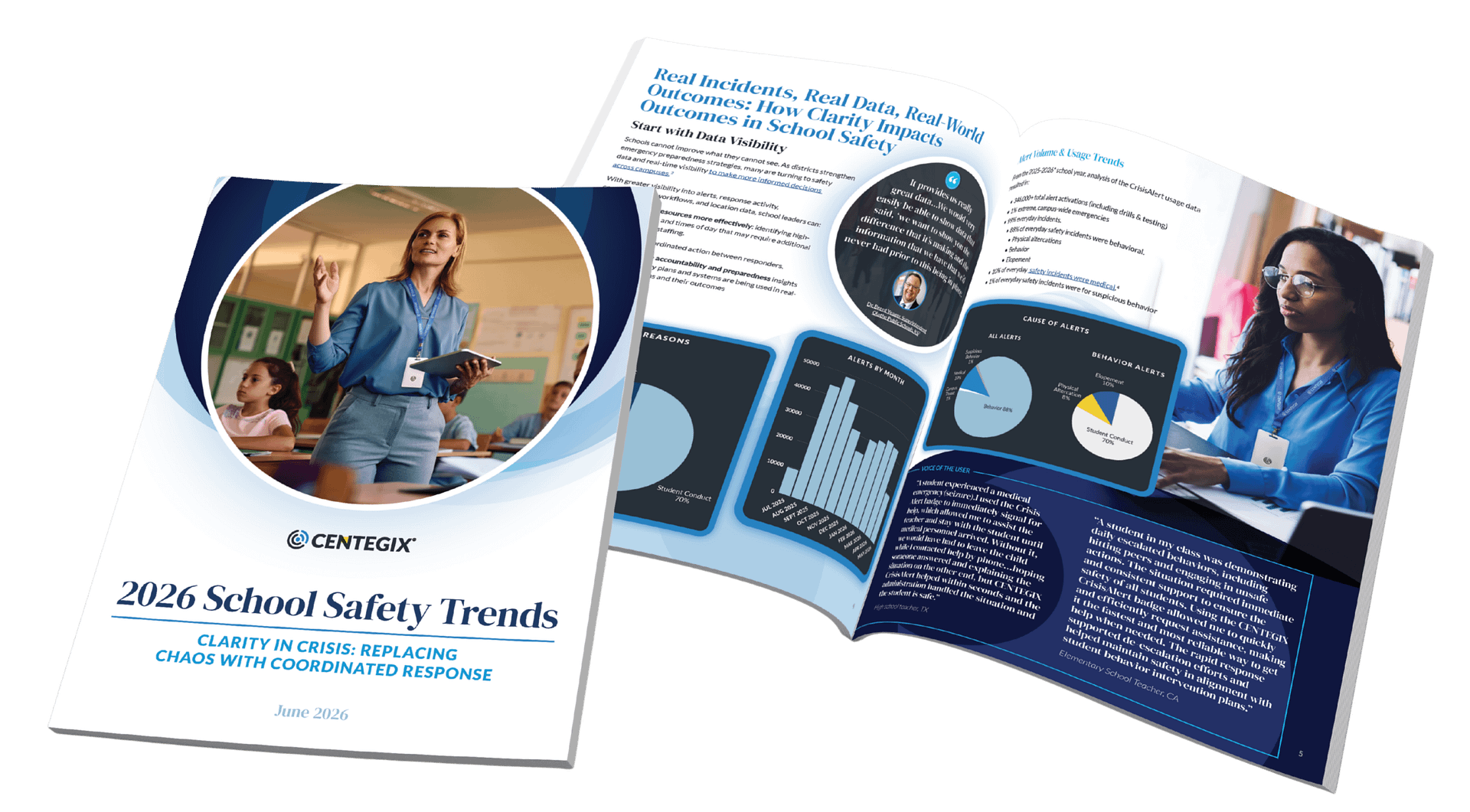
CENTEGIX Safety Report
2026 School Safety Trends
Clarity in Crisis: Replacing Uncertainty with Coordinated Response
Built from more than 346,000 wearable panic button alerts collected during the 2025–2026 school year, the 2026 School Safety Trends Report provides a comprehensive look at how K-12 schools are improving emergency response, strengthening preparedness, and enhancing campus safety nationwide through clarity.
Download your copy today.
Hear from Our Educators
We engage with teachers and staff every day to understand how CrisisAlert supports them, and here’s what they’ve shared:
A student was having trouble breathing and her vision was beginning to black out. We don’t have service in our building and it can be difficult to get ahold of the office staff, so having something to immediately alert them of emergency was incredibly helpful in a very scary situation.
I had a student who was refusing to follow directions and became very defiant. This student was beginning to get aggressive. I used my badge to alert our campus security monitor to remove the student from the situation. It is a very useful tool when the response was as immediate as it was.
A student was having a severe panic attack, trouble speaking, crying, not able to answer my questions as to what was wrong with her. I used the device to call for administrative help and it worked like it was designed to. Help arrived in a matter of seconds. I saw firsthand how well it works.
We chose CENTEGIX because we wanted our students, families and staff to
have confidence that help can be activated quickly, anywhere on campus,
with a reliable solution that meets the needs of our geographically and
culturally diverse district.
Championing Safe Schools with Educators and Educator Associations


CrisisAlert™ Is in a Class of Its Own
We don’t just raise the bar. We built it.
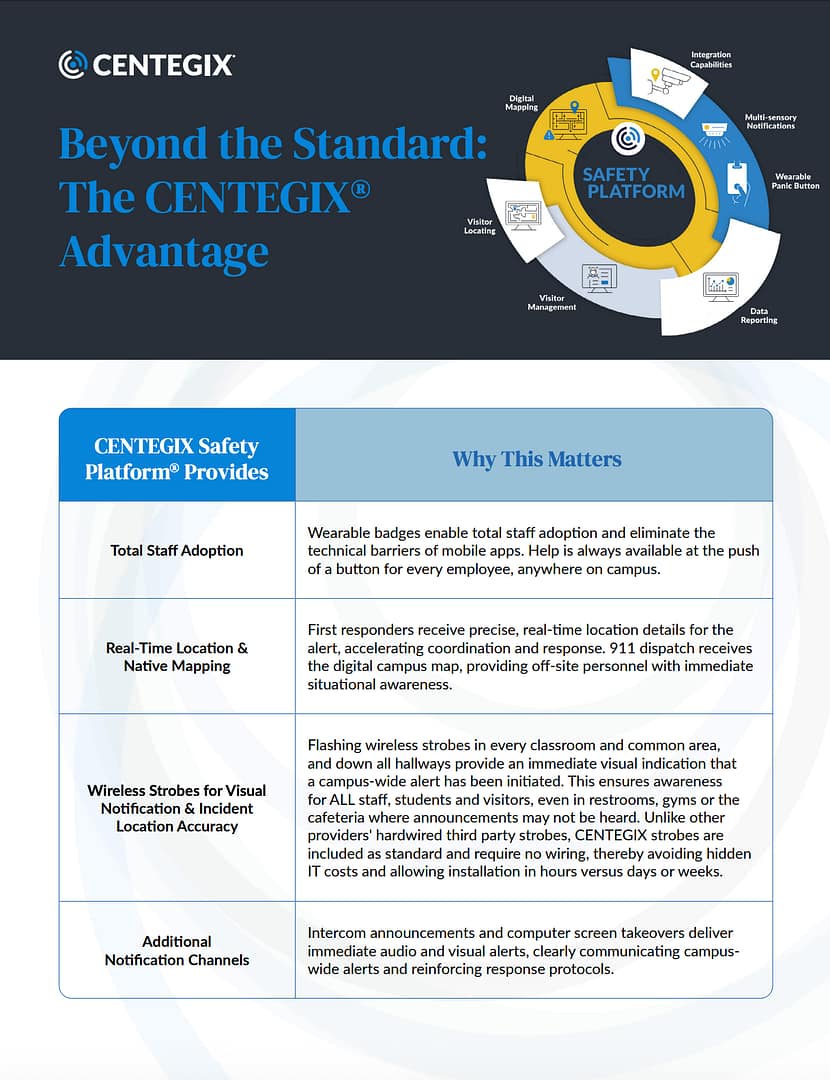
CrisisAlert leads the industry in wearable panic button technology. As the most trusted, proven, and deployed solution on the market, it delivers unrivaled reliability, redundancy, notification, and response capabilities.
Unlike other wearable panic buttons, CrisisAlert activates a fully integrated emergency response and notification system, including flashing strobes, intercom announcements, and computer screen takeovers. It’s the only solution with 100% campus-wide coverage that immediately sends a digital map to first responders with precise location details, down to the exact floor and room, detailing every safety asset in proximity of the alert, to protect your staff wherever they are.
In an Emergency, You Need CrisisAlert™
Adverse situations can happen at any moment—from everyday crises such as medical emergencies, severe weather, and physical altercations to extreme situations that threaten your entire campus. The faster you get help to the right location, the better the outcome.
See how our CrisisAlert wearable mobile panic button empowers staff to get help instantly in an emergency.

Empower Your Educators
with Safety
SOLUTIONS
INDUSTRIES
RESOURCES
COMPANY
PARTNERS
CONTACT
EVERY. SECOND. MATTERS.®