

Violence in healthcare has reached crisis levels. According to National Nurses United, 81.6 percent of nurses experienced workplace violence in 2023, marking a critical threat to both staff safety and patient care delivery. This has hospital leaders looking for ways to strengthen protection for patients and providers. Schools have also confronted safety challenges in recent years and have developed comprehensive response strategies that healthcare systems can adopt and adapt for their unique environments.

Schools Create Comprehensive Safety Cultures
Educational institutions implement proactive preparedness strategies for emergencies ranging from everyday incidents to extreme situations. Schools have learned that effective safety requires multilayered solutions. These integrated systems combine controlled access protocols, visitor management policies, live video locating capabilities, and wearable duress button technology to create integrated safety plans.
Modern school safety plans incorporate technology, hardware, protocols, and training., This holistic approach creates an environment where students, staff, and visitors feel secure. The Learning Policy Institute reports that schools implementing integrated support systems, including advisories and social-emotional learning programs, demonstrate improved safety outcomes while supporting positive development.
Healthcare facilities share many characteristics with educational institutions. Both serve as community spaces where vulnerable populations seek essential services. Both require open access while maintaining security. Both need rapid response capabilities for incidents ranging from medical emergencies to security threats. The strategies schools have refined through years of implementation offer valuable lessons for healthcare organizations seeking to protect their workforce while maintaining therapeutic environments.
Wearable Duress Buttons Empower Frontline Workers
Educational institutions nationwide equip teachers and staff with wearable duress buttons to mitigate incidents and accelerate emergency response. These devices provide immediate communication through simple button activation. Staff members can summon assistance discreetly without escalating situations or leaving vulnerable individuals unattended.
The technology proves particularly effective because it eliminates barriers to getting help. Traditional wall-mounted panic buttons require staff to reach specific locations, potentially escalating dangerous situations. Phone-based systems demand precious time for dialing and explaining emergencies, and may be susceptible to communication breakdowns if Wi-Fi or cellular service is unavailable. Wearable technology removes these obstacles, enabling instant alert activation from any location.
Trent North, from Douglas County Public Schools in Georgia, explains the transformative impact: "It empowers teachers to be in control of the safety of their room. They can summon a principal at the push of a button. We know where and we know who. That is a powerful technology."
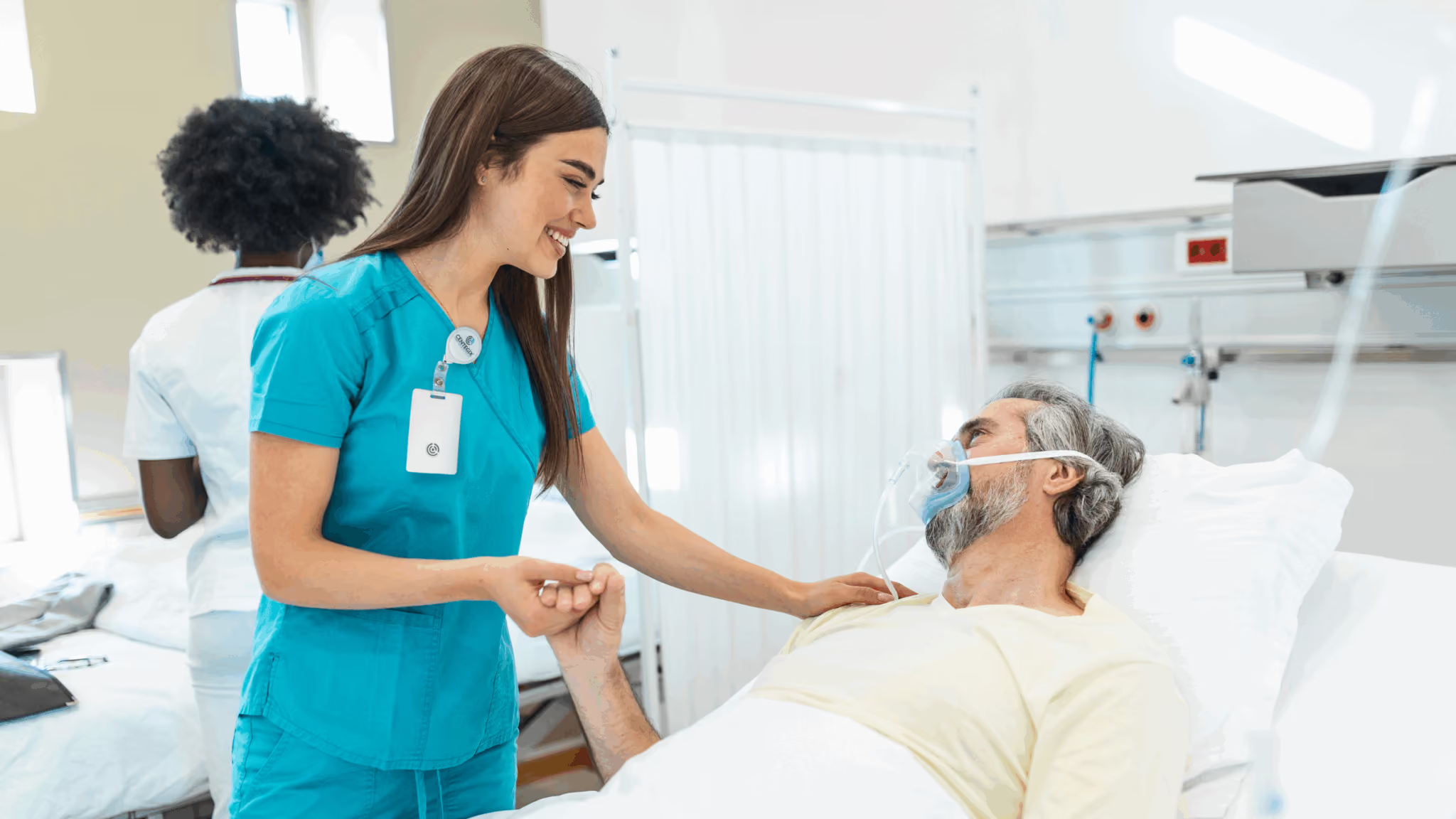
Healthcare workers face similar challenges requiring immediate response capabilities. A nurse encountering an aggressive patient, a technician witnessing a medical emergency in a hallway, or a receptionist dealing with a threatening visitor all need help immediately. Wearable duress button technology offers healthcare professionals the same level of empowerment as it does for educational staff. The devices enable workers to maintain focus on patient care while knowing support remains immediately accessible.
Having wearable technology provides healthcare workers with a feeling of control.This creates a supportive and protective environment for staff. This sense of safety translates into improved patient care and staff retention.
Learning from School Districts' Implementation Success
Dr. Ilan Alhadeff brings a unique perspective to safety discussions as both a physician and advocate for enhanced school safety measures. His daughter, Alyssa, was killed in the Marjory Stoneman Douglas High School shooting in February 2018. His advocacy helped pass Alyssa's Law in ten states, requiring wearable panic alarm technology in public schools.
Dr. Alhadeff recalls his own near-miss with workplace violence early in his medical career, "I narrowly missed encountering a gunman in the hospital ER solely because I forgot something and had to return upstairs. While tragedy was avoided in my case, too often, it is not."
His insights bridge the gap between education and healthcare safety needs. "When the supposedly safe spaces of healing and learning become targets, we must look at ways beyond hardening the exteriors to help prevent such violence within buildings. For our healthcare systems, the answer may lie within our schools," he explains.
The legislation bearing his daughter's name mandates the use of silent, mobile panic alarms that connect directly to law enforcement. These devices empower every staff member to notify responders in an emergency, while providing notification capabilities campus-wide. Dr. Alhadeff emphasizes these systems work equally well in healthcare settings: "These wearable panic alarms are not just outfitted for classrooms: they can be utilized in any workplace setting, including a healthcare system."
Healthcare-specific benefits make the technology particularly valuable for medical facilities. Dr. Alhadeff notes: "Wearable, mobile duress badge technology is tailor-made for the unique challenges faced by healthcare workers. It is discreet, easy to use, and can be customizable for each healthcare campus." The technology equips nurses, doctors, and other staff with badges that can signal an emergency through one-button activation. When an alert for support is initiated, responders receive the exact location and name of the person needing help. Staff can use their badge across all campuses within a healthcare system and avoid risking escalation by reaching for static panic buttons or indiscreetly calling for help.
Staff Well-being as a Safety Foundation
Violence in healthcare directly impacts staff mental and emotional health, and the National Safety Council emphasizes that workplace well-being extends beyond physical safety to encompass mental and emotional health. Moderate to severe distress links directly to higher workplace incident risk, while sleep problems contribute to approximately 13 percent of work injuries.
Schools have pioneered integrated approaches supporting both safety and performance. Social-emotional learning programs, mental health supports, and restorative practices create environments where staff and students can thrive. The Learning Policy Institute found that schools implementing these support systems, including "advisories and social-emotional learning programs that support relationships, and a well-designed system for adding more intensive, individualized interventions," demonstrate measurably improved safety outcomes.
Healthcare organizations can adapt these proven strategies to address their unique stressors. Comprehensive well-being programs that acknowledge human limits while providing robust support systems reduce incidents and improve retention. The NSC recommends treating risk to well-being like any other safety hazard: assess, prioritize, and integrate mitigation strategies into existing safety management systems.
Creating cultures that prioritize staff well-being requires systematic approaches rather than checkbox compliance. Successful programs may start small with employee assistance programs, paid time off, and flexible work policies, and then expand based on organizational needs and frontline feedback.

Safety-First Investment Mindset
Kenneth Dyer, Superintendent of Dougherty County School System, articulates a principle healthcare leaders must embrace: "When the priority is safety, organizations don't look at this as an expense. They see it as an investment. And there is no investment too high when the return is safety."
This perspective shift transforms safety discussions from cost-center debates to strategic investments in organizational sustainability. Healthcare facilities investing in safety systems report improved staff retention, reduced workers' compensation claims, and enhanced patient satisfaction scores. The return on investment extends beyond financial metrics to include immeasurable benefits like preserved lives and prevented trauma.
CENTEGIX Solutions for Healthcare Implementation
CENTEGIX® has translated educational safety successes into healthcare-specific solutions. The CENTEGIX Safety Platform® serves as the center of a comprehensive safety plan, integrating multiple technologies for a coordinated response.
CrisisAlert™ wearable duress buttons enable healthcare workers to signal for help immediately from anywhere on campus. The system provides precise location information, enabling responders to reach emergencies rapidly. Safety Blueprint® digital mapping displays facility layouts including safety equipment locations, while Visitor Management systems authenticate campus visitors.
These integrated solutions work together, creating safety ecosystems. When activated, the system simultaneously alerts appropriate responders, displays precise incident locations, can engage nearby cameras for situational awareness, and can initiate facility-wide notifications. These coordinated efforts reduce critical response time while providing responders with essential information.
Education's Playbook for Healthcare
Educational institutions have developed proven strategies for protecting staff and students through comprehensive safety approaches. Healthcare organizations can implement these same principles, adapting them for clinical environments while maintaining therapeutic atmospheres.
The combination of wearable duress button technology, integrated well-being programs, and a safety-first investment mindset creates environments where healthcare workers feel protected and patients receive optimal care. Healthcare leaders seeking to enhance workplace safety can explore how wearable duress button solutions proven in educational settings translate to medical facilities.