In long-term care and rehabilitation settings, Workplace Violence Prevention must account for a very different care environment than in an acute care hospital or outpatient clinic. Teams are not managing quick, transactional interactions. They are caring for the same residents day after day, often building close relationships while navigating cognitive decline, behavioral health concerns, physical limitations, and emotionally charged moments. In these settings, nurse safety is not a side issue. It is directly tied to staff confidence, resident well-being, and the ability to deliver consistent, compassionate care.
For organizations serving older adults, including long-term care, rehabilitation, and geriatric care communities, the challenge is especially complex. Incidents are often close-range, deeply personal, and difficult to predict. A caregiver may be helping with bathing, feeding, repositioning, or medication administration when a resident suddenly becomes aggressive or distressed. In other cases, staff may need to respond to resident-to-resident conflict in hallways, common areas, or private rooms. These are not hypothetical risks. They are part of the daily safety landscape and require response strategies tailored to the realities of caregiving.
The unique safety landscape of long-term care
Long-term care environments operate on trust, routine, and proximity. Staff members are physically close to residents throughout the day, often in rooms or semi-private spaces where visibility is limited. They may be working alone or with only a small team nearby. That combination creates a serious challenge when an incident unfolds quickly.
Many residents in these settings live with dementia, Alzheimer’s disease, or other conditions that can affect memory, communication, and behavior. According to the National Institute on Aging, dementia can involve changes in mood, behavior, and judgment that make care interactions more complicated and, at times, unpredictable. Staff may also care for residents with behavioral health conditions, mobility limitations, or pain-related distress. Even routine interactions can become volatile when a resident feels confused, overwhelmed, or frightened.
That reality changes the conversation around nurse safety. The risk is not always a large-scale emergency. More often, it is an everyday incident that escalates in seconds while the caregiver is physically closest to the situation and farthest from immediate help.

Why incidents in long-term care can escalate so quickly
In long-term care, some of the highest-risk moments happen during necessary, hands-on care. If a resident becomes combative, disoriented, or emotionally overwhelmed when a staff member is within very close proximity, there may be very little time to react.
These incidents can also be difficult for others to detect right away. A caregiver in a resident room may not be visible from the hallway. A verbal call for help may not carry far enough. A colleague may be assisting another resident down the hall. On larger or more spread-out campuses, response time can stretch even further.
This is where the operational challenge becomes clear. Long-term care leaders are not only trying to reduce violence or aggressive incidents. They are trying to reduce the time between the start of an incident and the arrival of help. When that gap is too wide, minor incidents can escalate, leading to staff injuries, poor resident outcomes, and diminished organizational confidence.
Why traditional response methods fall short
Many long-term care communities still rely on methods that were never designed for high-stress, fast-moving situations. A staff member may be expected to shout for help, find a wall-mounted button, reach for a phone, or use a radio. Each of those steps creates a delay.
Verbal calls for help are unreliable in busy care environments. Static wall buttons only work if someone can reach them. Phones and radios may not be at hand during direct care, and even when they are, they often require multiple steps at exactly the wrong moment. In an incident, simplicity matters.
Long-term care also presents a coverage challenge. Staff do not stay in one place. They move through resident rooms, hallways, common spaces, dining areas, therapy areas, and outdoor spaces. If a response method only works in part of the building, it leaves gaps that staff will immediately feel.
That is why response planning must go beyond policy. It has to reflect caregivers’ lived experience. Safety solutions have to be accessible where incidents occur, not just where previous technology has traditionally been installed.
The cost of a delayed response
When help is delayed, the impact reaches far beyond the immediate event. Staff injuries can lead to workers’ compensation claims, lost time, and ongoing physical or emotional strain. Repeated exposure to unsafe situations can accelerate burnout among a workforce already under pressure. A recent survey completed by CENTEGIX found that 75 percent of healthcare workers have experienced feelings of burnout in the last year. Among those, nearly two-thirds cited safety concerns as contributing factors.
There is also the effect on residents and families. Delayed response can increase the likelihood of injury, emotional distress, and loss of trust in the care environment. The same survey report found that 48 percent of healthcare workers said personal safety concerns impact their ability to deliver compassionate care.
The long-term care sector continues to face significant staffing strain. The U.S. Bureau of Labor Statistics projects strong demand for nursing roles, which makes retention a strategic issue for care organizations. In that context, nurse safety is not only a clinical concern. It is a workforce stability issue.
Leaders must consider compliance, documentation, and the broader expectation that organizations are taking practical steps to ensure a safe environment for both staff and residents. When teams do not have immediate access to help, the burden falls back on the caregiver in the moment. That is not a sustainable model.

What effective incident response looks like in long-term care
An effective response strategy in long-term care has to be immediate, simple, and dependable. Staff need a way to call for help without leaving the resident, searching for a device, or drawing more attention than necessary. Response capabilities must also work consistently across the entire campus, not just select locations.
That means the right approach should support several essentials.
- First, it should give staff immediate access to help.
- Second, it should work in resident rooms, hallways, common areas, and outdoor spaces.
- Third, it should be simple enough to use effectively under stress.
- Fourth, it should support caregivers who often work independently.
- And finally, it should help the right people respond quickly with enough clarity to take action.
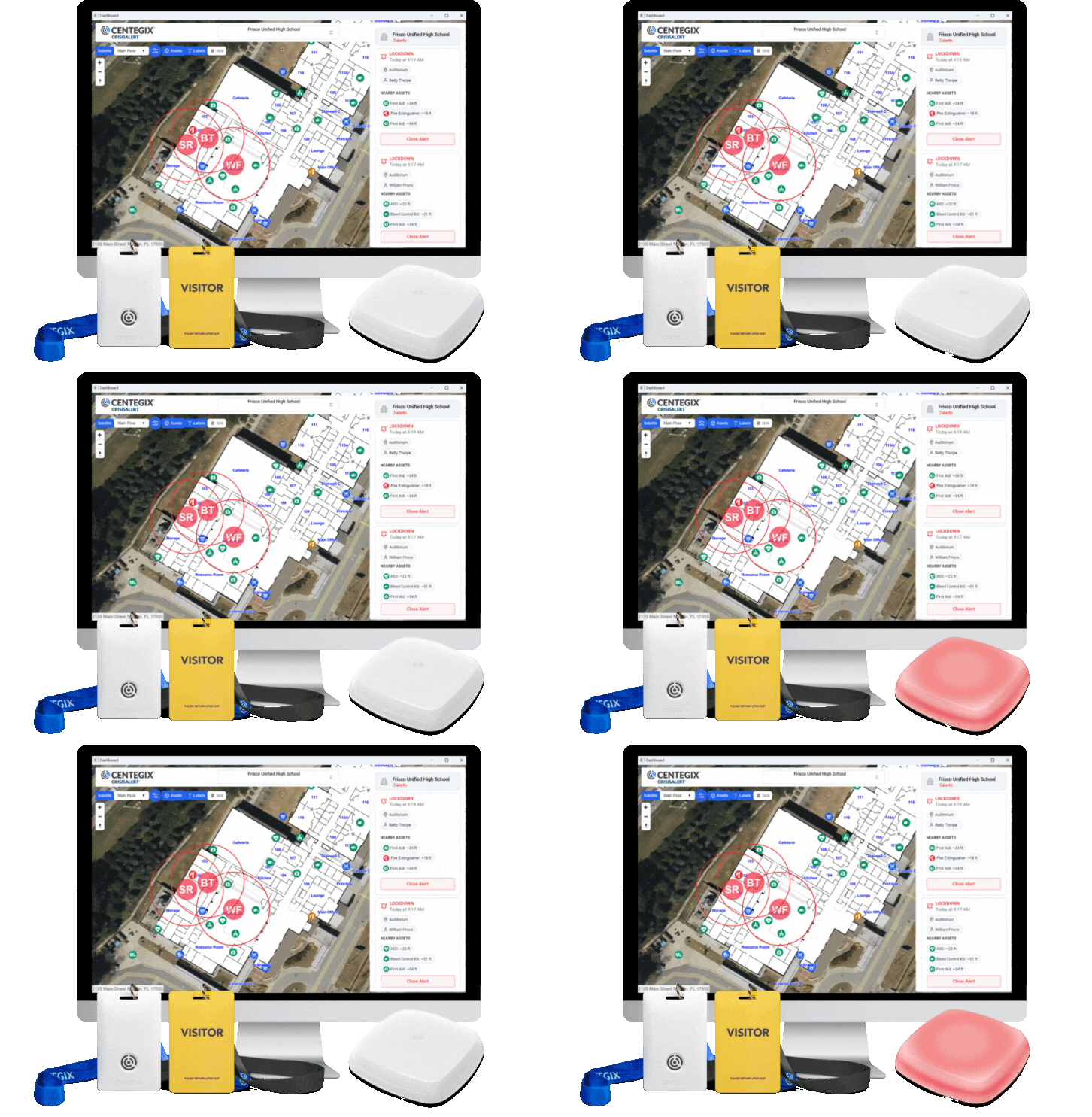
That is where the value of the CENTEGIX Safety Platform® becomes relevant for long-term care leaders. Rather than adding complexity, the platform supports faster, clearer, and more coordinated responses when every second matters. A staff member equipped with a CENTEGIX wearable duress button can signal for on-site help the moment support is needed. There is no need to unlock a phone, dial a number, or move toward a wall-mounted device.
Just as important, the Safety Platform helps replace confusion with coordinated action. Teams know what is happening more quickly, reducing uncertainty in the moment and helping responders move with purpose. In environments where incidents are personal, close-range, and often difficult to predict, that kind of clarity matters.

How CENTEGIX supports nurse safety in real care environments
For long-term care teams, the value is not about adding another tool for staff to manage. It is about removing barriers between the start of an incident and the arrival of help.
Immediate access is one of the clearest benefits. Staff can discreetly call for assistance while remaining focused on the resident. That matters in settings where escalation can happen if a resident senses panic or disruption. The goal is not to create more stress in the room. It is to get help moving quickly and quietly.
Coverage is another critical factor. Long-term care staff do not work at a single station or in a controlled treatment area. They move constantly across the facility. A response strategy that supports every person, every place, every time helps reduce the gaps that often appear in traditional systems.
Reliability also matters. In a stressful moment, staff should not have to wonder whether the alert will be received or whether the right team members will understand what is happening. The Safety Platform is built around reducing delays, improving clarity, and supporting coordinated response. For leaders focused on operational readiness, that means the safety strategy can support both day-to-day incidents and broader preparedness goals.
This has practical value for administrators, nursing directors, and operators. When staff feel supported, they are more likely to feel confident in their environment. When teams respond faster and more cohesively, organizations are better positioned to reduce injury-related costs, strengthen retention, and create a safer experience for residents and families.
A safer standard for long-term care
Long-term care organizations are built around relationships, consistency, and compassion. Safety should support those values, not complicate them. The right response strategy provides caregivers with a faster path to help, gives leaders greater confidence in their readiness, and helps create a more stable environment for residents.
That is why nurse safety deserves attention at the operational level. It affects retention, morale, incident outcomes, and the everyday experience of care delivery. It is also one of the clearest ways an organization can show staff that their well-being matters.
For long-term care and rehabilitation leaders, a stronger response model is not just about preparing for worst-case scenarios. It is about helping caregivers feel supported in the moments that happen every day. Learn how the CENTEGIX Safety Platform can help strengthen nurse safety while supporting a more confident, coordinated care environment.