The pressure behind that change is substantial. OSHA states that workplace violence is a major concern for employers and employees nationwide, and federal data shows 740 fatal work injuries due to violent acts in 2023. Healthcare workers remain among the most exposed groups, which is one reason the issue continues to command so much attention.
The broader context is just as important. In the 2025 Crisis Prevention Institute annual report, 37% of healthcare workers surveyed said they were considering leaving the field because of the mental and physical strain caused by violence, while over 19% had changed or left jobs, and 4% had already left the profession entirely. The same report says these pressures contribute to annual losses of roughly $3.9 million to $5.8 million per facility.
Against that backdrop, several clear trends are emerging for 2026.

A Stronger Focus on Workplace Violence in Healthcare as a Workforce Issue
One of the clearest shifts is that safety is now being discussed alongside staffing, retention, and burnout rather than as a separate security topic. That makes sense. If employees do not feel safe, they are less likely to stay, less likely to recommend the workplace to others, and less likely to feel supported in high-stress environments.
The 2026 Healthcare Safety Trends report frames this directly. It ties violence prevention to workforce stabilization and organizational resilience, rather than treating each as a separate initiative. The same report notes that turnover for a single bedside RN is $61,110 and and that every 1% change in RN turnover can save or cost a hospital $289,000 annually.
That helps explain why healthcare leaders are paying more attention to flexible scheduling, better support systems, and practical tools that help employees feel protected in the moment. The conversation is moving beyond symbolic gestures. Staff want to know whether they can get help quickly, whether leadership is listening, and whether safety investments reflect their real day-to-day risks.
Prevention Strategies Are Moving From Defensive to Proactive
Another major trend is a shift from defensive posture to offensive prevention. For years, many organizations focused on what to do after a violent incident took place. Now, there’s a stronger emphasis on preparation. Leaders want to prevent escalation, identify patterns faster, and build systems that reduce confusion before a situation worsens.
The CPI report found that only 1 in 4 healthcare organizations qualified as “Leaders” in workplace violence prevention training, while 74% fell below that benchmark. It also found that organizations with established violence prevention policies and frequent training had greater confidence that staff felt safe.
CENTEGIX® has also noted the measurable progress in this area. Its blog on how violence in healthcare fuels hospital staff safety investments notes that organizations prioritizing effective workplace violence prevention programs rose from 17% in 2024 to 26% in 2025. That does not mean the problem is solved. It does mean more providers are beginning to invest earlier and more deliberately.
This matters because prevention is not only about stopping worst-case scenarios. It is also about reducing the everyday uncertainty that wears people down over time.

Technology Investment Is Expanding Campus-Wide
A third trend is broader investment in technology to elevate safety across the full care environment. Healthcare organizations are exploring tools to reduce response time, improve visibility, and enable more coordinated action during emergencies. That includes AI-assisted monitoring tools, weapons detection, visitor management systems, and wearable duress buttons with user-activated locating.
The critical distinction is that healthcare leaders are becoming more selective. Not every technology builds trust. Employees are more likely to support systems that empower them to signal for help when needed, than systems that continuously track whether a duress alert is activated or not. As a result, there is growing interest in user-activated tools that are practical and designed to build workforce confidence.
This is where platform thinking has become more important than point solutions. A fragmented collection of tools may create more noise than value. A unified approach can help organizations improve speed, clarity, and coverage simultaneously, especially in large, complex facilities where seconds matter.
ROI Is No Longer Optional
Safety spending is now under the same scrutiny as any other strategic investment. In 2026, healthcare leaders are under pressure to show that every dollar improves outcomes, protects staff, or reduces loss. That is driving a stronger demand for measurable return on investment.
This trend is reinforced by the financial costs of turnover, injuries, disruptions, and reputational damage. OSHA’s business case for safety notes that workplace injuries, illnesses, and fatalities cost the country billions every year, while the healthcare-specific evidence from CPI and CENTEGIX ties violence directly to labor loss and operational strain.
The result is a more disciplined approach to safety decisions. Healthcare organizations want tools and strategies they can justify not only on moral grounds, but also on operational and financial grounds. That is one reason data visibility is becoming so important. Leaders want to see response times, incident patterns, and areas where safety investments are producing measurable gains.

Accountability for Safety Is Increasing
Public scrutiny and legal pressure are also reshaping the conversation. In February 2026, Leelamma Lal, a nurse who survived a brutal patient attack in 2025, filed suit against HCA Florida Palms West Hospital, HCA, and its security contractor. According to local reporting on the lawsuit, the complaint alleges negligence and inadequate security at a hospital with a documented history of violence.
That case is important because it reflects a wider expectation that healthcare organizations must do more than react after an incident occurs. The CENTEGIX 2026 Healthcare Safety Trends report says high-profile incidents in 2025 increased awareness and helped drive bipartisan efforts to protect healthcare workers, while state-level proposals, such as Illinois SB 1435, would require hospitals to provide wearable duress buttons attached to employee ID badges.
The same report argues that safety is now a board-level issue. On page 13, Jennifer Schmitz, ENA Chief Clinical Officer, says leaders will need to recognize that their duty of care extends not only to patients, but also to staff.
That line captures the industry’s direction. Accountability is broadening. It now includes culture, preparedness, enforcement, and whether leadership is willing to invest before the next incident occurs.
What This Means for CENTEGIX
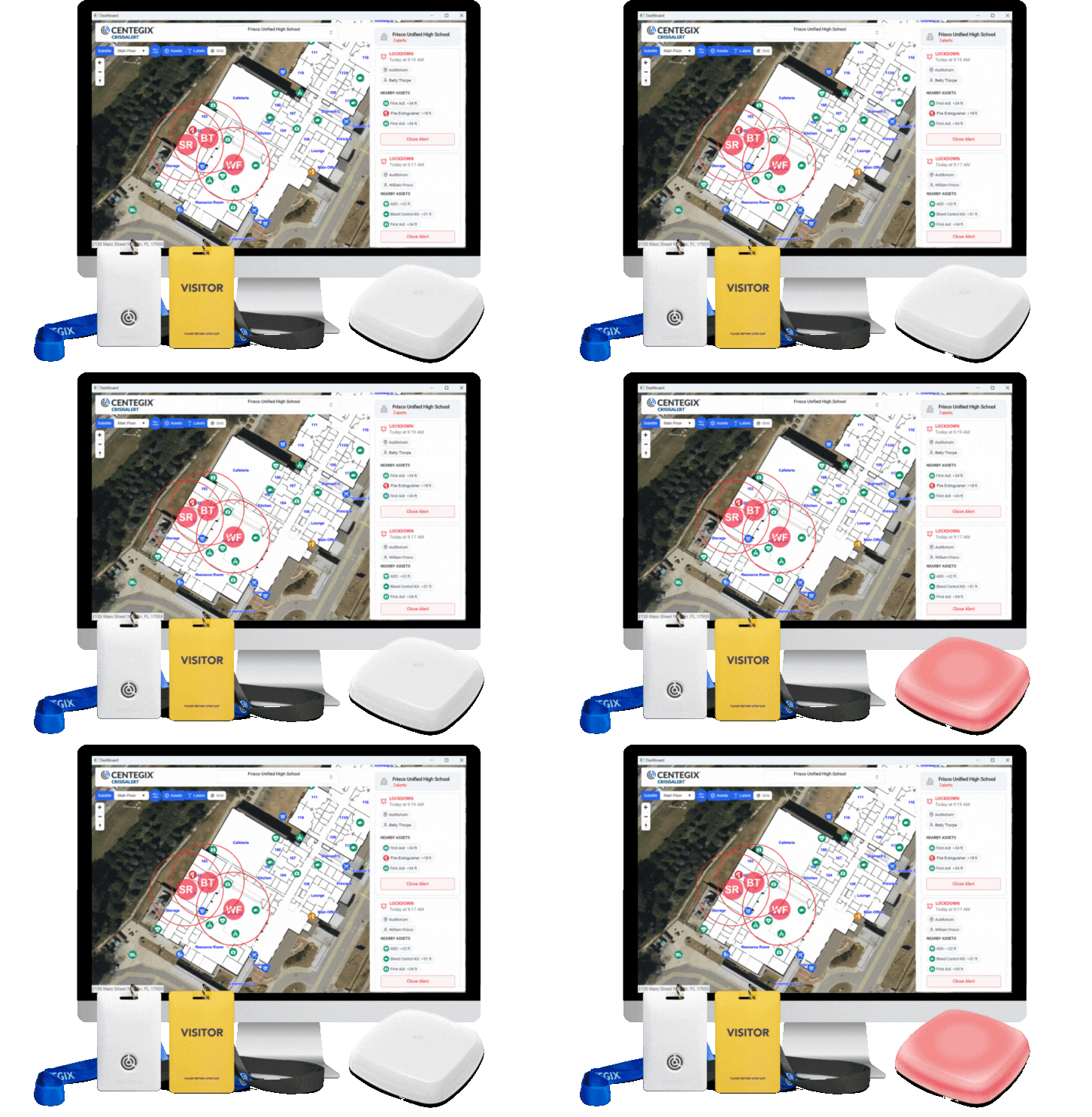
For organizations responding to these trends, the CENTEGIX Safety Platform® aligns with what healthcare leaders increasingly need from safety infrastructure.
Speed matters because delays make emergencies worse. With the Safety Platform, employees equipped with a wearable duress button can request help from their precise location right away. Engineered networks prioritize alerts and do not depend on Wi-Fi or cellular service, which helps teams act faster when every second counts.
Clarity matters because confusion slows response. Situational awareness can help staff and responders quickly understand what is happening, replacing uncertainty with coordinated action.
Coverage matters because gaps undermine confidence. In a hospital or health system, people move constantly across units, floors, and buildings. A platform built for every person, every place, every time supports a more reliable response across a full care environment.
Intelligence matters because organizations need to learn from each event. Better visibility into response patterns and performance helps leaders refine training, strengthen readiness, and make more informed decisions about prevention.
That combination aligns with the broader direction of 2026. Healthcare leaders want safety investments that protect employees, support accountability, and deliver measurable value over time.
Looking Ahead
The closing message of the 2026 trends report is straightforward: violence prevention, workforce stabilization, and organizational resilience are no longer parallel goals. They are connected.
That is likely to define healthcare safety strategy throughout 2026. The organizations that respond well will be those that treat workplace violence in healthcare as a core business issue, not an isolated concern. They will invest in prevention earlier, demand clearer ROI, and build systems that help employees feel supported in real time.
To see how a unified platform can support stronger workplace violence prevention strategies in healthcare, explore the CENTEGIX Safety Platform.